In our communication with clients, we often hear questions like these:
• If a pilot test fails, who investigates the problem, and who is accountable?
• After the contract is signed, how will the project move forward? Who will coordinate it, and how soon can results be seen?
• How many people will have access to our core formulation?
• What documents and data will be delivered at the end? Can they be used directly for production-line design?
• Compared with piecing together multiple suppliers, what exactly makes a full-process service stronger?
These are the questions almost every client quietly uses as criteria when evaluating a pilot testing partner.
In this article, we will not focus on equipment parameters. Instead, we will answer the questions behind them: the five soft strengths of DODGEN’s pilot testing service.
When Problems Occur, How Are They Investigated? Both Process and Experience Are Essential
Many pilot testing providers will tell you that when process fluctuations occur, the first steps are to check instruments, review operating records, organize cross-functional review when necessary, and return to lab-scale trials for reproduction. This process is correct; it ensures that troubleshooting follows a disciplined and traceable path.
However, a process only ensures that nothing is missed. What truly helps a project avoid detours is experience.
▌ Typical Scenario: Local Concentration Overheating During Reaction
The process may run perfectly at lab scale, yet once scaled up, excessive local concentration can trigger polymerization. This risk is almost invisible at small scale. If the team relies solely on step-by-step procedural checks, multiple rounds of comparative testing may be needed before the cause is identified.
DODGEN’s team has accumulated experience from similar projects. As a result, local concentration control can be built into the process design stage as a key consideration, reducing a significant amount of trial and error.
Similar experience also shows up in the following areas:
• When multiple abnormalities occur at the same time, such as excessive impurities, yield fluctuations and fouling/scaling, the team can quickly judge whether they share the same root cause, greatly narrowing the scope of investigation.
• Equipment selection and unit-operation coupling: which separation units are better suited to certain materials, and which processes are prone to temperature gradients after scale-up. These judgments come from real projects and cannot be found in textbooks.
Process is the basic safeguard, while experience is the core capability that accelerates project progress and reduces the cost of trial and error. This capability can only be built through time and a substantial number of projects.
Service Process | How Is a Pilot Testing Project Completed?
Many people think pilot testing simply means replacing lab equipment with larger equipment. In reality, a complete pilot testing project goes through six stages, each with clear pass criteria:
• Process evaluation and project initiation
Based on general criteria and unit-specific indicators, DODGEN evaluates whether the lab-scale process is ready to enter pilot testing, clarifies project objectives, schedule and budget, and completes project initiation.
• Kilogram-scale simulation run
A kilogram-scale unit is used to simulate the structure of the pilot plant and continuous operating conditions, exposing scale-up issues in advance. Directly skipping levels and moving straight to the pilot plant is strictly prohibited except under special circumstances.
• Pilot plant operation
Before operation, raw-material inspection, equipment calibration, SOP preparation and safety risk assessment (PHA/HAZOP) are completed. The operation is then carried out according to dedicated emergency response plans for the four major units, with data recorded throughout the entire process.
• Cross-functional review
After a single batch or project stage is completed, a cross-functional review is organized to identify the root causes of issues. Optimization proposals are first fed back to lab-scale or kilogram-scale verification for reproduction and validation, and only then are they applied to the next iteration.
• Qualified delivery / project closure
Once the process meets the client’s requirements, the results are fed back to Application Technology (pre-sales) and confirmed with the client before project closure. Deliverables include a complete test report, waste treatment plan, cost estimate and equipment improvement recommendations.
• Handover to process design
If the client intends to move forward, the process design team becomes involved to discuss material balance, operating parameters and related issues. After the process technology package is completed, it is delivered to the client for engineering design and construction.
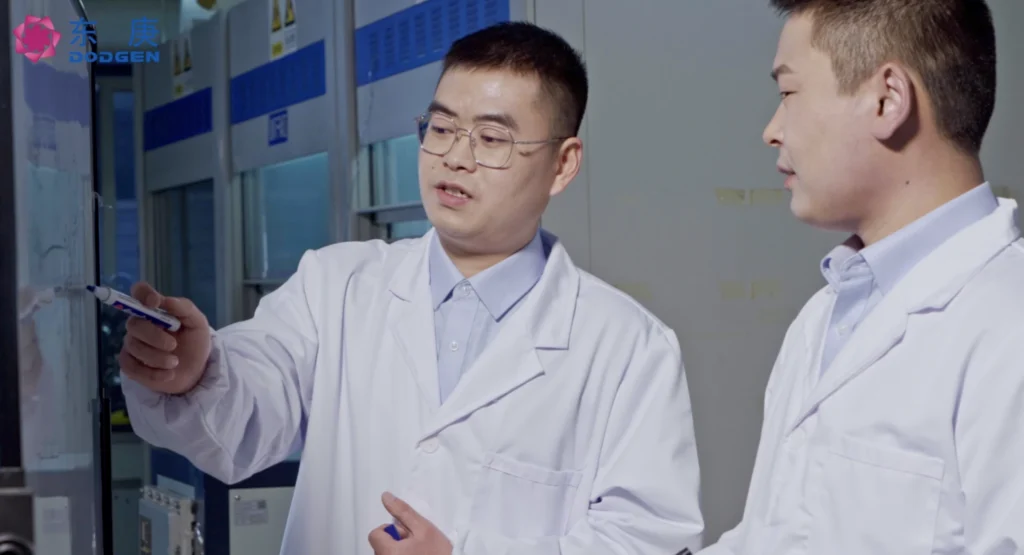
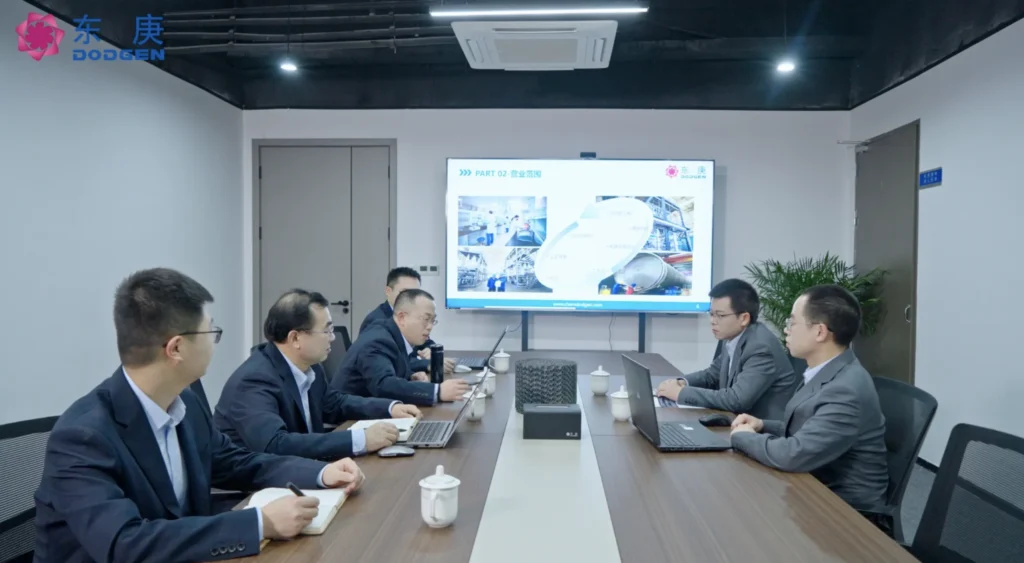
The entire process can be summarized in two phrases: stepwise scale-up and closed-loop iteration.
• Stepwise scale-up: each level of scale-up is based on effective validation at the previous level, with no risky leapfrogging.
• Closed-loop iteration: after a deviation is identified, the optimization plan must return to lab-scale or kilogram-scale equipment for revalidation before entering the next round of pilot testing.
Although this rhythm may appear to add steps, it actually eliminates scale-up risks progressively at the lowest possible cost.
Deliverables | Not Just a Report, but a Set of Traceable Assets
DODGEN benchmarks its standards against industry registration requirements and GMP specifications, managing full-process data across six dimensions: personnel, equipment, materials, methods, environment and measurement.
▸ Batch production records, process parameters, test reports and abnormal-event handling are fully documented throughout the process.
▸ Each batch is assigned a unique number, enabling full traceability from raw-material receipt to finished-product discharge.
▸ Original spectra or chromatograms are retained for key testing indicators.
Beyond “producing a qualified batch,” pilot testing must provide usable data and solutions for subsequent scale-up, registration and commercialization. However, the value of deliverables can vary greatly.
Basic Deliverables
Complete experimental and analytical data
• Complete test report and analytical report
• Standard Operating Procedures (SOPs)
• Sample materials
• Original testing spectra/chromatograms and batch records
Pilot Testing Special Deliverables
Scale-up data for industrialization
• Wastewater, waste gas and solid waste treatment plan
• Cost estimate and consumption data
• Equipment improvement recommendations
• Standardized process technology package that can be used directly for production-line technology transfer
These materials can be used directly for industrial design and can significantly shorten the subsequent production-line commissioning cycle. The output of pilot testing is not limited to “this run succeeded”; it becomes a set of accumulated knowledge assets.
Confidentiality: More Than Signing an Agreement
Process data security is a common concern among clients. What truly determines the effectiveness of confidentiality is not the agreement itself, but refined access control.
DODGEN’s approach includes:
▸ The number of personnel involved in each project is proactively kept as limited as possible.
▸ Project participants sign project-specific confidentiality agreements and assume independent confidentiality obligations for that project, rather than relying solely on company-level general agreements.
▸ For projects with higher confidentiality requirements, DODGEN works with the client to further segment information based on the “need-to-know for each role” principle. Operators only access the information necessary to perform their specific tasks.
A need-to-know management approach is more actionable and genuinely binding than a broad, generic confidentiality agreement.
Full-Process Support from Project Initiation to Delivery
A pilot testing project often spans several weeks to several months and crosses multiple stages. Providing support from the early stage all the way through delivery is valuable in itself. The material understanding, operating experience and risk records accumulated early on naturally carry through to later stages, reducing information loss during handovers.
DODGEN has accumulated systematic pilot testing and engineering experience across multiple fields, including:
▸ Degradable materials: equipment and processes related to Polylactic Acid (PLA), among others
▸ Electrolyte materials: FEC, Lithium Bis(fluorosulfonyl)imide (LiFSI), and related materials
▸ Specialty chemicals and bio-based chemicals
Core unit operations cover distillation, melt crystallization, extraction and devolatilization. Where equipment is involved, these correspond to DODGEN’s Separation Equipment portfolio, including Melt Crystallizer, Extraction Tower and Devolatilizer. Each field is supported by continuous engineering practice.
Real Case | Isosorbide (ISO) Project: From “Uncontrolled Impurities” to “Stable Batches”
DODGEN previously undertook an Isosorbide (ISO) pilot testing project in the field of specialty chemicals. At the lab scale, the process ran very stably and all parameters performed well. However, after scale-up into pilot testing, problems gradually emerged: impurity levels exceeded limits, and batch-to-batch variation became significant.

Through data analysis of batch production records, the team gradually identified the root causes:
▸ The impact of stirring configuration and feeding rate was not obvious at small scale.
▸ After scale-up, uneven material mixing caused localized side reactions.
After confirming the direction, the team optimized the stirring structure and adjusted the material dropwise-addition method. The solution was first reproduced and validated on lab-scale equipment before the pilot test was restarted.
Final results: all impurity indicators met the required standards, batch stability improved significantly, the process completed technology transfer smoothly, and commercial production was successfully implemented.
This case has become an important reference for DODGEN in handling issues such as uneven mixing after scale-up. It is also one of the most concrete examples of what “accumulated experience” means.
Connecting Lab Scale to Industrialization with Shorter Cycles and Faster Feedback
Pilot testing is only one part of DODGEN’s service system. From front-end lab-scale trials and process design to industrial scale-up of pilot testing results, clients can complete the full-process connection within the same team, ensuring that information is not lost and responsibilities remain continuous.
DODGEN aims to provide every client with a more stable and more predictable pilot testing experience by relying on these capabilities, which are just as important as equipment strength but often less visible.