What Is Structured Packing?

목차

Definition

Structured packing is a type of tower packing used in mass transfer equipment such as distillation columns, absorption towers, extraction towers, and reactive distillation systems.

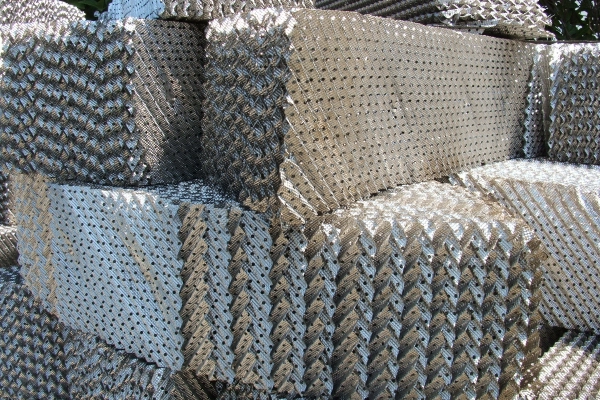
Unlike random packing, structured packing consists of regularly arranged corrugated sheets made from metal mesh, perforated metal, wire gauze, or thin plates. These sheets are assembled into blocks and stacked inside a tower to form packing layers. Adjacent sheets and layers are arranged with alternating corrugation directions to promote uniform fluid distribution and improve contact between vapor and liquid phases.

Its highly organized structure gives structured packing its name and distinguishes it from conventional random packing materials.

구조화된 포장

Structural Characteristics

Structured packing is typically manufactured by forming corrugated patterns on thin sheets and assembling them into modular sections.

According to traditional chemical engineering references, the corrugation angle is commonly arranged at approximately 30° or 45° relative to the horizontal direction. Within each packing block, neighboring sheets intersect with one another, while adjacent packing layers are installed with alternating orientations.

This configuration creates a large specific surface area and numerous flow channels, allowing vapor and liquid streams to contact efficiently throughout the column.

Operating Principle

The primary function of structured packing is to enhance mass transfer between gas and liquid phases.

As vapor flows upward and liquid flows downward through the packing, the structured channels distribute both phases across a large contact surface. This increases the opportunity for heat and mass transfer while reducing flow maldistribution.

The regular geometry of the packing also helps minimize pressure drop compared with many traditional tray designs, making it particularly attractive for separation processes that require high efficiency.

Industrial Relevance

Structured packing is widely used in separation processes where high mass transfer efficiency is required.

Common applications include:

  • Distillation columns
  • Absorption towers
  • Extraction systems
  • 용제 회수 장치
  • Vacuum distillation systems
  • Reactive distillation processes

Compared with many conventional packing materials, structured packing generally provides higher separation efficiency and improved column performance.

For this reason, it is often selected for processes involving high-purity products, difficult separations, or applications where energy efficiency is an important consideration.

Advantages of Structured Packing

The organized arrangement of structured packing provides several operational benefits:

  • High mass transfer efficiency
  • Large effective contact area
  • Low pressure drop
  • Improved liquid distribution
  • Better separation performance
  • Reduced energy consumption in many applications

These advantages have made structured packing a widely adopted solution in modern chemical processing and purification systems.

Selection Considerations

The selection of structured packing depends on process requirements such as operating pressure, feed composition, separation targets, and column dimensions.

Engineers typically evaluate:

  • Mass transfer requirements
  • Pressure drop limitations
  • 내식성
  • Material compatibility
  • Capacity requirements
  • Operating conditions

Proper packing selection can significantly influence product purity, energy consumption, and overall process economics.

Related Technologies

Structured packing is commonly associated with:

  • Distillation Columns
  • 반응성 증류
  • Extraction Towers
  • 칼럼 내부
  • Mass Transfer
  • Solvent Purification

관련 라이선스 기술 및 장비

화학 공정 솔루션

애플리케이션

지속 가능성

메시지 보내기

반응 및 분리 전문, 저탄소 기술 파트너

도겐-화학-공정-회사

문의하기

고객의 요구 사항을 충족하기 위해 최선을 다합니다.