What Is Plug Flow in Chemical Engineering?

목차

정의

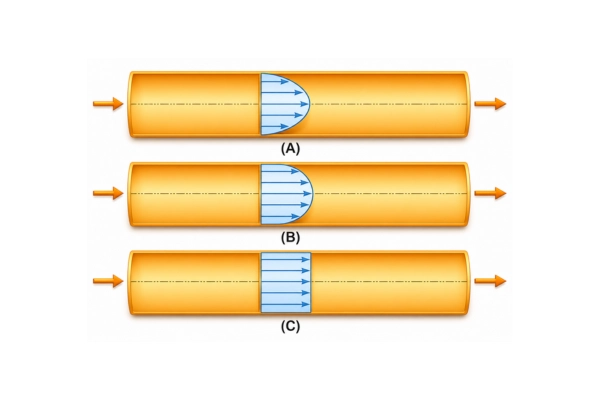
Plug flow is an idealized flow model in which fluid moves through a reactor in the form of “plugs,” with no axial mixing along the flow direction and complete radial mixing across any cross-section.

In a plug flow system, each fluid element behaves as an independent segment, maintaining its identity as it travels through the reactor. All elements have the same velocity, resulting in a uniform residence time distribution.

Plug Flow in Chemical Engineering

Core Concept

The fundamental assumption of plug flow is:

  • No back-mixing in the flow direction
  • Uniform velocity profile across the reactor cross-section
  • Complete mixing in the radial direction
  • Continuous progression of reaction along reactor length

This allows the reactor to be modeled as a series of differential volume elements, each undergoing the same reaction mechanism but at different conversion stages.

Mathematical and Engineering Significance

Plug flow is widely used in reactor design because it simplifies the relationship between reaction kinetics and conversion.

In engineering terms, a plug flow reactor (PFR) allows:

  • Direct correlation between reactor length and conversion
  • Predictable residence time distribution
  • Simplified mass and energy balance equations
  • High conversion efficiency for many reaction systems

This model is especially important in chemical reaction engineering and process design.

산업 분야 적용

Plug flow behavior is commonly observed or approximated in industrial systems such as:

Continuous Flow Reactors

In modern chemical manufacturing, plug flow reactors are widely used for:

  • Fine chemical synthesis
  • 특수 화학제품 생산
  • Highly exothermic reaction systems
  • 제어된 중합 공정

These systems benefit from precise control over residence time and reaction progression.

Petrochemical and Material Production

Plug flow models are applied in:

  • Polymerization of engineering plastics
  • Production of intermediates such as MMA
  • High-purity chemical synthesis (e.g., LiFSI-related processes)
  • Gas-phase catalytic reactions

Continuous Manufacturing Systems

In advanced continuous production systems, plug flow behavior helps engineers:

  • Minimize back-mixing
  • Improve product consistency
  • Enhance reaction selectivity
  • Optimize conversion efficiency

This makes plug flow a core concept in modern Process Intensification strategies.

Engineering Interpretation

From an engineering perspective, plug flow is an idealization rather than a perfect physical reality.

Real reactors often exhibit deviations due to:

  • Axial dispersion
  • Turbulence effects
  • Non-uniform velocity profiles
  • Reactor wall interactions

However, plug flow remains a highly useful approximation for designing and scaling industrial reactors.

Process Design Considerations

When designing systems approximating plug flow, engineers evaluate:

  • Reactor geometry (tube length and diameter)
  • Flow velocity distribution
  • Reaction kinetics
  • Heat transfer efficiency
  • Residence time control
  • Mixing characteristics

These parameters directly influence conversion, selectivity, and yield.

Relationship to DODGEN Technologies

Plug flow concepts are closely connected to:

It serves as a foundational model for many continuous manufacturing technologies used in advanced chemical production.

Limitations of Plug Flow Model

Despite its usefulness, plug flow has limitations:

  • Assumes ideal flow behavior
  • Ignores axial dispersion effects
  • May oversimplify real industrial reactors
  • Requires correction factors in large-scale systems

Engineers often use it as a baseline model and refine it with experimental data.

관련 용어

  • Residence Time Distribution
  • 연속 흐름 반응기
  • 물질 전달
  • Axial Dispersion
  • Conversion
  • Reaction Engineering
  • CSTR (Continuous Stirred Tank Reactor)

관련 라이선스 기술 및 장비

화학 공정 솔루션

애플리케이션

지속 가능성

메시지 보내기

반응 및 분리 전문, 저탄소 기술 파트너

도겐-화학-공정-회사

문의하기

고객의 요구 사항을 충족하기 위해 최선을 다합니다.