What Is a Crystallizer?

목차

Definition

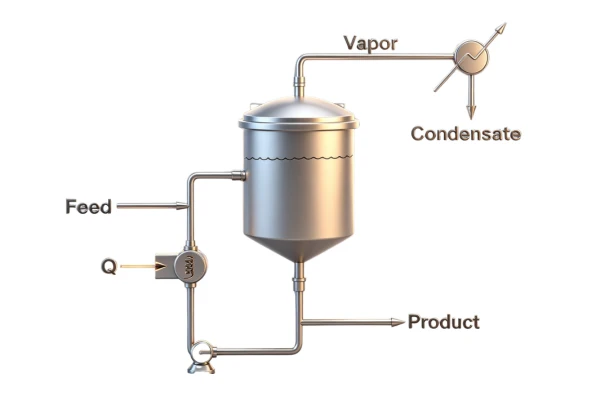
A crystallizer is a piece of process equipment used to perform crystallization operations. Its primary function is to promote the formation and separation of solid crystals from a solution by creating a controlled state of supersaturation.

In industrial practice, crystallization is commonly achieved by cooling a saturated solution or by removing part of the solvent through evaporation. Once the solution reaches a sufficient degree of supersaturation, dissolved substances begin to form crystals and separate from the liquid phase.

Crystallizers are widely used in chemical, pharmaceutical, food, and advanced material manufacturing processes where product purity, crystal quality, and material recovery are important requirements.

Crystallizer

How a Crystallizer Works

The operation of a crystallizer is based on the principle of supersaturation.

When a solution contains more dissolved material than can remain stable under specific operating conditions, crystal nucleation and crystal growth begin to occur. A crystallizer provides the controlled environment necessary to regulate these processes and achieve the desired crystal characteristics.

Two common approaches are:

  • Cooling crystallization, where reduced temperature lowers solubility and promotes crystal formation.
  • Evaporative crystallization, where partial solvent removal increases concentration until crystallization occurs.

The selected approach depends on material properties, process requirements, and desired product specifications.

Main Types of Crystallizers

According to traditional chemical engineering classifications, crystallizers can generally be divided into two categories.

Evaporative Crystallizers

These systems remove part of the solvent to achieve supersaturation and induce crystallization.

They are commonly used when temperature reduction alone cannot provide sufficient crystallization efficiency.

Cooling Crystallizers

These systems achieve crystallization primarily through temperature reduction without significant solvent removal.

Cooling crystallizers are widely applied to materials whose solubility changes substantially with temperature.

Operating Modes

Crystallizers can be configured in different operating arrangements depending on production requirements.

Common classifications include:

  • Batch crystallizers
  • Continuous crystallizers
  • Agitated crystallizers
  • Non-agitated crystallizers

They may operate under atmospheric pressure or vacuum conditions depending on process characteristics and product requirements.

Industrial Relevance

Crystallizers play an important role in separation and purification technology.

Unlike simple evaporation or filtration processes, crystallization can simultaneously recover valuable products and improve product purity. During crystallization, desired compounds form solid crystals while many impurities remain in the mother liquor, making crystallization one of the most effective purification methods in chemical manufacturing.

For high-value specialty chemicals and advanced materials, crystallization is often a critical step that directly influences product quality, yield, and commercial value.

Applications in High-Purity Chemical Production

Crystallizers are widely used in the production of high-purity chemical products where impurity control is essential.

일반적인 애플리케이션은 다음과 같습니다:

  • Specialty chemicals
  • 정밀 화학 제품
  • Pharmaceutical intermediates
  • 전자 화학 물질
  • Advanced materials

In many industrial processes, crystallization serves as a final purification stage following reaction, extraction, concentration, or solvent recovery operations.

For products with strict purity specifications, crystallizer performance can directly affect crystal purity, particle size distribution, product recovery, and downstream processing efficiency.

Melt Crystallization and Advanced Purification

One of the most important developments in modern crystallization technology is melt crystallization.

Unlike conventional solution crystallization, melt crystallization separates and purifies materials directly from a molten phase without relying on solvents. This technology is particularly valuable for producing high-purity chemicals because it can achieve effective separation while reducing solvent consumption and simplifying downstream processing.

Melt crystallizers are increasingly used in advanced chemical manufacturing where high purity, process efficiency, and product consistency are critical requirements. As a result, melt crystallization has become an important purification technology in specialty chemical and advanced material production.

Selection Considerations

When selecting a crystallizer, engineers typically evaluate:

  • Product solubility characteristics
  • Crystal size requirements
  • Desired product purity
  • Production capacity
  • 에너지 소비
  • Batch versus continuous operation

The choice of equipment can significantly influence operating costs, purification efficiency, and final product quality.

Related Technologies

관련 라이선스 기술 및 장비

화학 공정 솔루션

애플리케이션

지속 가능성

메시지 보내기

반응 및 분리 전문, 저탄소 기술 파트너

도겐-화학-공정-회사

문의하기

고객의 요구 사항을 충족하기 위해 최선을 다합니다.