Is PLA Toxic? Ensuring Food-Grade Safety in Biodegradable Plastic Production Lines

목차

What Determines the Risk Profile of PLA in Food Applications

Polylactic acid, commonly referred to as PLA, is widely used in biodegradable packaging and disposable food-contact products. Questions about material risk and suitability remain common across both consumer and industrial contexts.

PLA is not inherently harmful under controlled conditions. Food-contact performance depends on material composition, processing control, and the use environment. This article examines how outcomes are managed across the full production chain, with a focus on production line design and contamination control.

PLA food safe packaging material biodegradable plastic safety

Why PLA Is Considered Non-Toxic at the Material Level

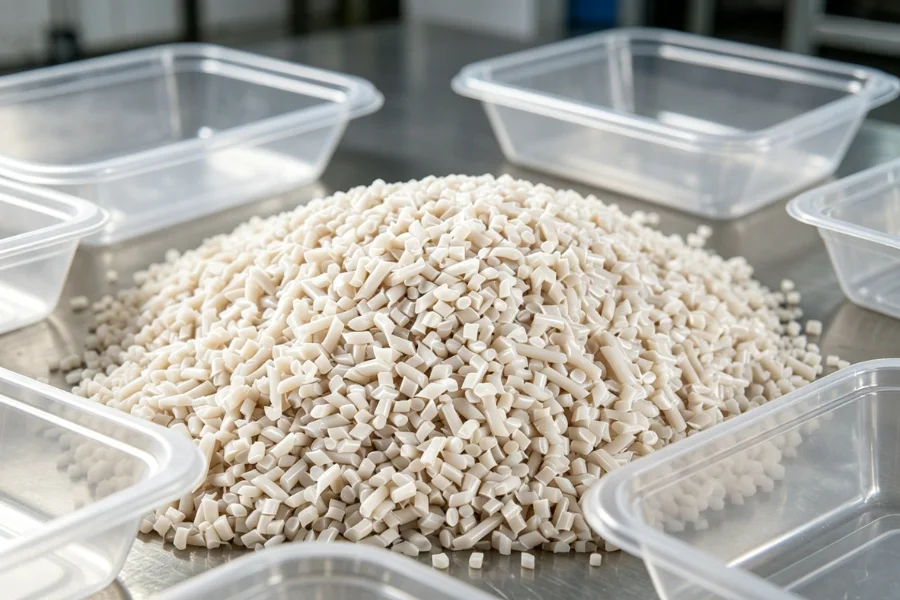
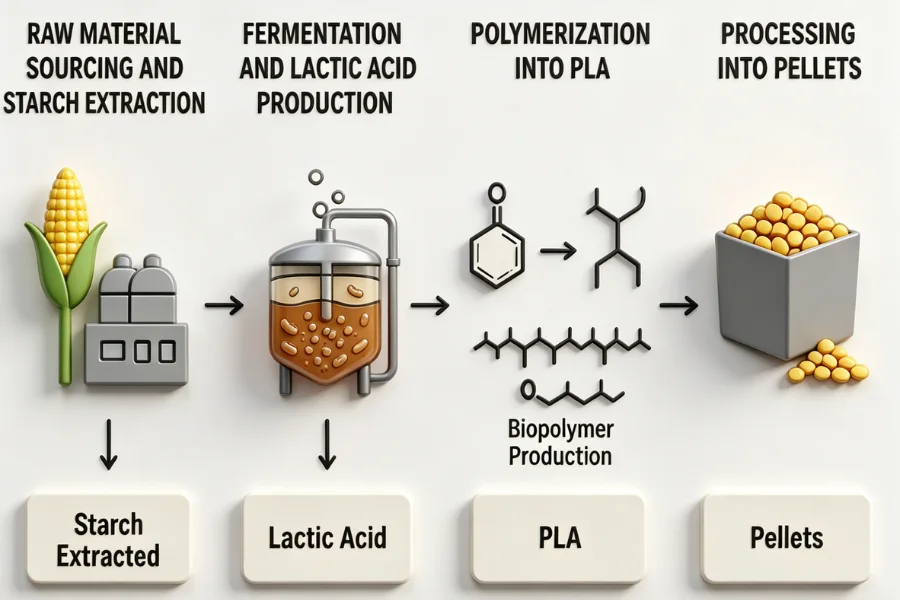
PLA is a thermoplastic polymer derived from renewable feedstocks such as corn starch or sugarcane. Through fermentation and polymerization, lactic acid is converted into a polymer suitable for industrial applications.

PLA material from corn starch biodegradable polymer non toxic

From a material standpoint:

  • Pure PLA polymer is classified as acceptable for food contact under regulatory frameworks such as FDA 21 CFR and EU Regulation 10/2011
  • PLA does not contain commonly restricted substances such as bisphenol A or phthalates
  • Under controlled degradation conditions, PLA breaks down into lactic acid, a compound naturally metabolized by the human body

These properties support the use of PLA in regulated food-contact environments. However, material-level characteristics alone do not ensure compliance in finished products.


Key Factors That Affect PLA Food Safety

Compliance in PLA food-contact applications is not defined by the polymer alone. It is influenced by multiple interacting factors across formulation, processing, and usage.

Additives and Material Composition Risks

The base PLA polymer is stable and non-toxic. Risk is primarily introduced through formulation components.

  • Colorants, fillers, and processing modifiers may not meet food-contact requirements
  • Under heat or prolonged exposure, certain additives may migrate into food matrices
  • Documentation such as Certificates of Compliance and Material Safety Data Sheets is required to verify suitability

Temperature Limits and Usage Conditions

PLA has a relatively low thermal tolerance compared to conventional polymers.

  • The glass transition temperature is approximately 60°C
  • Exposure to elevated temperatures can result in deformation and increased migration potential
  • PLA is therefore restricted to ambient or low-temperature applications

Surface Structure and Bacterial Contamination Risks

Surface characteristics directly affect hygiene performance.

  • Porous or layered structures can retain residues and support microbial growth
  • Reusable applications require smooth surface finishing and controlled cleaning procedures
  • Design simplification reduces contamination retention points

Degradation and Microplastic Risks

Degradation behavior introduces additional considerations in lifecycle assessment.

  • Under controlled industrial composting, PLA degrades into lactic acid
  • Under uncontrolled conditions, incomplete degradation may generate oligomers or micro- and nano-scale particles
  • Available studies indicate that smaller degradation products may exhibit increased biological reactivity, although human data remains limited

Regulatory compliance therefore depends on maintaining material stability and avoiding uncontrolled degradation pathways.


How Production Lines Ensure Food-Grade PLA Safety

Even when certified PLA resins are used, production line conditions determine whether the final product meets regulatory requirements. Contamination introduced during processing cannot be removed downstream.

Where Contamination Happens in PLA Production

Key contamination pathways include:

  • Oil vapor and hydrocarbon residues from vacuum systems
  • Metal particles resulting from pipe corrosion or equipment wear
  • Airborne particulates and microbial contamination
  • Residual materials from prior production cycles

Each pathway introduces variables that directly affect product purity.

Equipment Requirements for Clean PLA Manufacturing

Effective contamination control requires appropriate equipment selection.

  • Oil-free vacuum systems
    Dry screw or claw vacuum pumps eliminate lubricant exposure and prevent hydrocarbon contamination
  • Stainless steel piping systems
    Materials such as SUS304 or SUS316L provide corrosion resistance and prevent particle release
  • Controlled cleanroom environments
    Production areas typically operate at ISO 7 level or higher, supported by filtration systems to reduce particulate load

Clean System Design for Food-Grade Production

System integration determines long-term operational stability.

  • Clean-in-place capability supports repeatable sanitation procedures
  • Dead-zone elimination reduces material stagnation and residue buildup
  • Dedicated production lines prevent cross-material contamination

Food-contact compliance is therefore achieved through system-level control rather than isolated equipment choices.


Best Practices for Maintaining Food-Grade PLA Quality

Consistent performance requires coordinated control across all stages of production and use.

Raw Material Control

  • Source PLA resins with verified compliance to FDA and EU food-contact standards
  • Review Certificates of Compliance and Material Safety Data Sheets for formulation transparency

Processing Control

  • Maintain processing temperatures below degradation thresholds, typically under 200°C depending on formulation
  • Avoid cross-material contamination through dedicated equipment allocation
  • Implement scheduled cleaning and microbial monitoring

Post-Processing and Use

  • Apply certified coatings where required to reduce surface porosity
  • Define clear usage limits, particularly for temperature exposure
  • Recommend manual cleaning using mild detergents and controlled water temperature

How PLA Compares to Other Food-Safe Plastics

Material selection depends on thermal requirements, durability expectations, and compliance considerations.

MaterialCompliance LevelHeat Resistance일반적인 사용
PLAAcceptable when certified~60°CCold food packaging, disposable items
PETGGenerally acceptable~80°CReusable containers
PPHigh stability~100°CHot food, microwave applications
ABSNot suitable~105°CNon-food applications

PLA is suitable for controlled, low-temperature applications where biodegradability is required.


Final Assessment of PLA Safety in Food Applications

PLA provides a viable platform for biodegradable food-contact materials. However, compliance with food-contact standards is not an inherent property of the material.

Outcomes depend on three controlled factors:

  • Verified raw material composition
  • Contamination-controlled production systems
  • Defined processing and usage conditions

도겐 has experience in high-purity process design and crystallization systems used in pharmaceutical manufacturing. These capabilities are directly applicable to biodegradable polymer production lines where material purity, contamination control, and system integration determine final product compliance.

For manufacturers seeking to align biodegradable materials with food-contact requirements, production system design remains the determining factor.

자주 묻는 질문

Is PLA toxic to humans

Pure PLA is generally considered non-toxic under controlled conditions. Risk may arise from uncertified additives or degradation products formed during uncontrolled processing or environmental exposure.

PLA can be used for food packaging when certified materials are selected and production systems are designed to prevent contamination throughout processing and handling.

PLA is not suitable for high-temperature food applications. Exposure above approximately 60°C may cause deformation and increase the potential for material instability.

PLA may generate micro- or nano-scale particles under incomplete degradation conditions. Current research indicates potential biological interaction, though long-term human impact remains under evaluation.

관련 라이선스 기술 및 장비

화학 공정 솔루션

애플리케이션

지속 가능성

메시지 보내기

반응 및 분리 전문, 저탄소 기술 파트너

도겐-화학-공정-회사

문의하기

고객의 요구 사항을 충족하기 위해 최선을 다합니다.