Corrosion Challenges in Hydrocyanic Acid Processing: Material Selection for Pumps and Valves

목차


System Characteristics of Hydrocyanic Acid Service

시안화 수소산 (HCN) is a weak acid with pKa ≈ 9.2 and limited dissociation in aqueous systems. Under dry, high-purity conditions at temperatures near ambient, general corrosion rates on common alloys remain low.

In industrial operation, HCN is rarely present as a pure system. It is volatile at near-ambient temperature, highly toxic at low ppm levels, and sensitive to trace impurities. As a result, equipment integrity is governed by impurity-driven corrosion and containment reliability rather than nominal acid strength.

hydrocyanic acid processing pumps and valves material selection


Baseline Corrosion Behavior Under Controlled Conditions

Under dry conditions with impurity levels below detection limits:

  • Austenitic stainless steels such as 316L typically exhibit corrosion rates below 0.01 mm/year at temperatures below 25°C
  • Passive film stability is maintained in the absence of oxidizing or halide species
  • Uniform corrosion remains the dominant mechanism

These conditions are not stable in most process environments and should not be used as the basis for material selection.


Impurity-Driven Corrosion – Dominant Engineering Constraint

Corrosion behavior in HCN systems is governed by the presence of water, halides, oxidants, and acidic contaminants. These factors alter both electrochemical conditions and material stability.

Water Content

Water concentrations above approximately 0.5–1.0 wt% introduce hydrolysis and secondary reactions. Observed effects include:

  • Formation of acidic or basic byproducts
  • pH variation across the system
  • Increase in corrosion rates of stainless steels to 0.05–0.20 mm/year depending on temperature

Halide Contamination

Chloride concentrations as low as 10–50 ppm are sufficient to initiate localized corrosion in austenitic stainless steels under tensile stress.

  • Pitting potential decreases significantly in the presence of Cl⁻
  • Stress corrosion cracking has been observed in 304 and 316 grades at temperatures above 20°C
  • Localized penetration can occur without measurable uniform corrosion

Oxidizing Species

Trace oxygen or oxidizing acids disrupt passive films:

  • Passive breakdown potential decreases
  • Transition from passive to active corrosion occurs
  • Localized corrosion rates exceed 0.5 mm/year in affected regions

Acidic Contaminants

The presence of HCl or H₂SO₄ shifts the system from weakly acidic to strongly acidic behavior:

  • Corrosion rates increase by an order of magnitude relative to pure HCN
  • Uniform corrosion becomes significant in addition to localized attack

Corrosion Mechanism Model

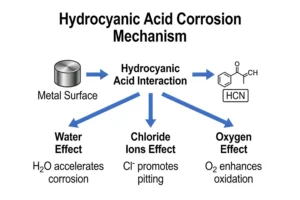
Corrosion in HCN systems follows a conditional transition model:

  • Base state – low corrosion under dry, impurity-free conditions
  • Trigger state – introduction of water, halides, or oxidants
  • Failure state – localized corrosion, pitting, crevice corrosion, and stress corrosion cracking

Material selection must be based on the trigger and failure states rather than the base state.

hydrocyanic acid corrosion mechanism with impurities chloride water oxygen


Typical Failure Modes in Pumps and Valves

Failure Mode Trigger Condition Observed Impact
Stress corrosion cracking Cl⁻ ≥ 20 ppm with residual stress Rapid crack propagation and loss of containment
Pitting corrosion Local chloride concentration Penetration without warning
Crevice corrosion Flange and seal interfaces Accelerated localized attack
Elastomer degradation Chemical incompatibility Loss of sealing pressure and leakage

Failure progression is typically non-linear and may lead to sudden release rather than gradual degradation.


Material Selection Framework

Selection Criteria

Material selection must be based on:

  • Full chemical composition including trace impurities
  • Temperature and pressure envelope
  • Flow velocity and erosion potential
  • Operating mode including startup and upset conditions

Lifecycle cost must include maintenance intervals, failure probability, and safety impact.


Metallic Materials

Austenitic Stainless Steels

  • 304 / 304L
    Acceptable only for dry, high-purity HCN with impurity levels below critical thresholds
    Failure risk increases significantly above 10 ppm chloride
  • 316 / 316L
    Baseline material for controlled systems
    Corrosion rates remain below 0.05 mm/year in low-impurity conditions
    Risk of localized corrosion persists in the presence of halides
  • Stabilized grades (321)
    Improved resistance to intergranular corrosion in welded assemblies

Duplex Stainless Steels

Duplex alloys such as 2205 exhibit improved resistance to stress corrosion cracking. However:

  • Pitting resistance remains dependent on PREN value
  • Performance is not stable in mixed impurity systems without validation

Nickel-Based Alloys

  • Hastelloy C-276
    Maintains corrosion rates below 0.01 mm/year in mixed impurity systems including halides
    Resistant to pitting, crevice corrosion, and stress corrosion cracking
    Considered a primary material for high-risk HCN service
  • Monel 400
    Compatible with HCN systems but typically selected based on specific process requirements
  • Inconel 625
    Provides stable performance in mixed acid environments but is selected selectively due to cost

Titanium Alloys

Titanium Grade 2 and Grade 7 demonstrate stable performance in:

  • Oxygen-containing systems
  • Low-halide environments

However:

  • Fluoride concentrations above trace levels result in rapid degradation
  • Application requires impurity control and validation testing

Non-Metallic and Lined Materials

Fluoropolymers

  • PTFE
    Chemically inert across all typical HCN compositions
    No measurable corrosion under standard conditions
  • PFA / FEP
    Similar chemical resistance with improved manufacturability
  • PVDF
    Mechanical strength advantages with acceptable chemical resistance

Limitations include:

  • Reduced resistance to abrasion
  • Limited structural strength
  • Sensitivity to vacuum-induced deformation

Sealing Systems – Primary Containment Risk

Seal failure represents the highest probability of release in HCN systems.

Material Performance 참고
FKM (Viton) Stable Standard sealing material
PTFE-based seals Highly stable Preferred for high-integrity systems
NBR Conditional Limited use in non-critical service
EPDM Unstable Rapid swelling and degradation

Seal selection must consider both chemical compatibility and temperature-dependent mechanical properties.


Pump and Valve Configuration

Pump Systems

  • Centrifugal pumps require minimum flow control to prevent thermal damage to seals
  • Magnetic drive and canned motor pumps eliminate dynamic seals and reduce leakage probability
  • Diaphragm pumps provide high containment integrity for low-flow applications

Valve Systems

  • Bellows-sealed valves eliminate stem leakage paths
  • Lined valves provide chemical isolation in aggressive environments
  • Ball valves require antistatic design to mitigate electrostatic discharge risk

Threaded connections are not recommended due to crevice formation and incomplete decontamination.


Operating Envelope Control

  • Temperature maintained below 20°C to limit volatility and reaction kinetics
  • Flow velocity controlled to reduce erosion and electrostatic accumulation

At temperatures below −10°C, elastomer flexibility decreases and sealing force must be verified.


Safety Design and Maintenance

Design Measures

  • Dual sealing systems with pressure-monitored barrier fluids
  • Inert gas purging systems for isolation and maintenance
  • Grounding of all conductive components
  • High-integrity gasket systems for flange connections

Maintenance Practices

  • Scheduled seal replacement based on operating hours rather than failure
  • Full decontamination using inert gas and chemical neutralization prior to maintenance
  • Thickness monitoring at high-risk locations including elbows and valve seats

Failure to maintain sealing integrity is the primary cause of hazardous release.


Failure Scenario Analysis

Observed failure scenarios in HCN systems include:

  • Austenitic stainless steel exposed to 20–50 ppm chloride leading to stress corrosion cracking within months of operation
  • Elastomer seal swelling resulting in loss of sealing force and leakage
  • Lined components failing under vacuum or abrasive conditions

These scenarios demonstrate that failure is driven by localized conditions rather than average system chemistry.


Integrated Engineering Approach

Material performance in HCN service is determined by the interaction between process chemistry, operating conditions, and equipment design.

도겐 applies a process-integrated approach in API synthesis and crystallization systems involving HCN. Material selection is defined in relation to reaction composition, impurity evolution, and separation conditions, rather than nominal chemical identity.

This approach reduces dependence on conservative material selection and improves predictability of equipment performance over the operating lifecycle.


결론

Hydrocyanic acid systems are defined by impurity sensitivity and containment risk rather than intrinsic acid strength. Material selection for pumps and valves must be based on worst-case conditions, including trace impurities and process variability.

Reliable operation requires alignment between material capability, process control, and sealing integrity. A structured, data-based approach to selection and design is necessary to ensure both safety and long-term performance.

자주 묻는 질문

Why is HCN not considered a strong acid?

HCN is classified as a weak acid because it only partially dissociates in aqueous solution, with a dissociation constant of approximately 6.2 × 10⁻¹⁰. The strong carbon–hydrogen bond limits proton release. In industrial systems, its corrosion behavior is not determined by acidity, but by impurities such as water, halides, and oxidizing species.

Hydrochloric acid is significantly stronger than HCN. HCl dissociates almost completely in water, while HCN remains largely undissociated. Despite this, HCN systems can present higher engineering risk due to toxicity, volatility, and impurity-driven corrosion mechanisms that are not directly related to acid strength.

Hydrogen cyanide inhibits cellular respiration by binding to cytochrome c oxidase in mitochondria, preventing oxygen utilization at the cellular level. Exposure at concentrations above approximately 50 ppm can lead to rapid physiological failure. Toxicity, rather than acidity, defines the primary hazard in HCN processing environments.

HCN is more acidic than water, as indicated by its lower pKa value. However, both substances are weak proton donors. In practical systems, this difference has limited relevance to corrosion behavior, which is governed by impurity composition, temperature, and process conditions rather than intrinsic acid strength.

관련 라이선스 기술 및 장비

화학 공정 솔루션

애플리케이션

지속 가능성

메시지 보내기

반응 및 분리 전문, 저탄소 기술 파트너

도겐-화학-공정-회사

문의하기

고객의 요구 사항을 충족하기 위해 최선을 다합니다.