When developing a purification process, the most direct way to evaluate a technology is through data.
However, when assessing melt crystallization performance, the final product purity alone does not tell the whole story. Equally important is understanding how purity improves throughout the crystallization process.
The experimental results for nitrotoluene provide a representative example. Starting from a feed purity of approximately 75%, the product purity increased to around 93% after the first-stage 용융 결정화. A second crystallization stage further increased purity to approximately 98%, while a third stage ultimately achieved 99.85% purity.

These results reveal three important points.
First, the initial crystallization stage already delivers significant separation performance.
The increase from approximately 75% to 93% demonstrates that the target component can be effectively enriched during crystallization, while impurities are preferentially removed through the mother liquor and sweating fraction. This first stage is critical for determining whether the separation concept is technically feasible. If little improvement is observed after the initial crystallization, additional stages often provide limited benefit.
Second, multistage crystallization offers continuous purification capability.
After reaching approximately 93% purity in the first stage, the product could still be upgraded to around 98% in the second stage and further to 99.85% in the third stage. This indicates that impurities are not removed in a single step but can be progressively reduced through successive crystallization stages. For products requiring high purity, this characteristic gives multistage melt crystallization significant process design value.
Third, the crystallization behavior supports the analytical results.
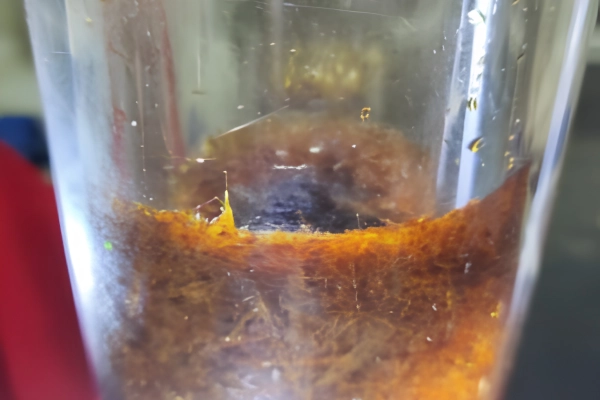
During the experiment, the material formed needle-like crystals that adhered well to the crystallization surface while allowing effective drainage of the mother liquor. These observations correlate closely with the measured purity improvements. In other words, the analytical data were not coincidental but were supported by favorable crystallization characteristics.
The results obtained with cyanophenol are equally illustrative. Starting from a feed purity of approximately 89%, product purity exceeded 97% after the first crystallization stage and surpassed 99% after the second stage. More importantly, the product color gradually became lighter throughout the purification process, suggesting that melt crystallization may also effectively remove colored impurities in addition to increasing the concentration of the target component.
The raspberry ketone study highlights another important aspect. Feed purity increased from approximately 91% to over 97% after the first stage and exceeded 99% after the second stage. However, the process was accompanied by challenges such as rapid crystallization, increased viscosity, and difficulty in mother liquor drainage. These results demonstrate that strong purification performance does not necessarily imply a simple process. Materials with high purification potential may still require careful control of the operating window.
Therefore, the value of melt crystallization cannot be summarized simply as “a purification method.”
Its advantages are reflected in at least four aspects.
The first is purity enhancement. Target products can achieve significantly higher purity through single-stage or multistage crystallization.
The second is color improvement. For some materials, the product becomes visibly lighter after crystallization, providing direct evidence of impurity removal.
The third is process cleanliness. 용융 결정화 typically requires little or no additional solvent, making it attractive for applications seeking to reduce solvent consumption.
The fourth is controllable purification intensity. By implementing one, two, or multiple crystallization stages, the degree of purification can be tailored to meet different product specifications.
Of course, melt crystallization is not a universal solution.
If a material cannot form a stable crystal layer, if the mother liquor cannot be effectively discharged, or if the crystal structure collapses during the sweating process, purification performance may be limited. Likewise, when the compositions of the product, mother liquor, and sweating fraction show minimal differences, the system may not be suitable for purification by melt crystallization alone.
For this reason, evaluating melt crystallization data requires consideration of three interconnected factors: the magnitude of purity improvement, the quality of the crystallization behavior, and the effectiveness of impurity rejection through the mother liquor and sweating fractions.
Only when all three aspects support one another can a melt crystallization process be considered a truly promising candidate for further development.