Global Fatty Acids Market Overview And Production Technologies

In-depth Analysis: Supply Chain, Production Technologies (with Emphasis on Distillation), Trends and Challenges

I. Executive Summary

This article gives a concise view of the global fatty acids sector (also called carboxylic acids or alkanoic acids), clarifying scope, size, and why it matters to buyers, producers, and investors.

Common Aliases

  • Fatty acids; carboxylic acids; alkanoic acids
  • Long-chain monocarboxylic acids; oleochemicals (as a product family)

Core End-Use Sectors

  • Food and nutrition (emulsifiers, acidulants), pharmaceuticals and nutraceuticals
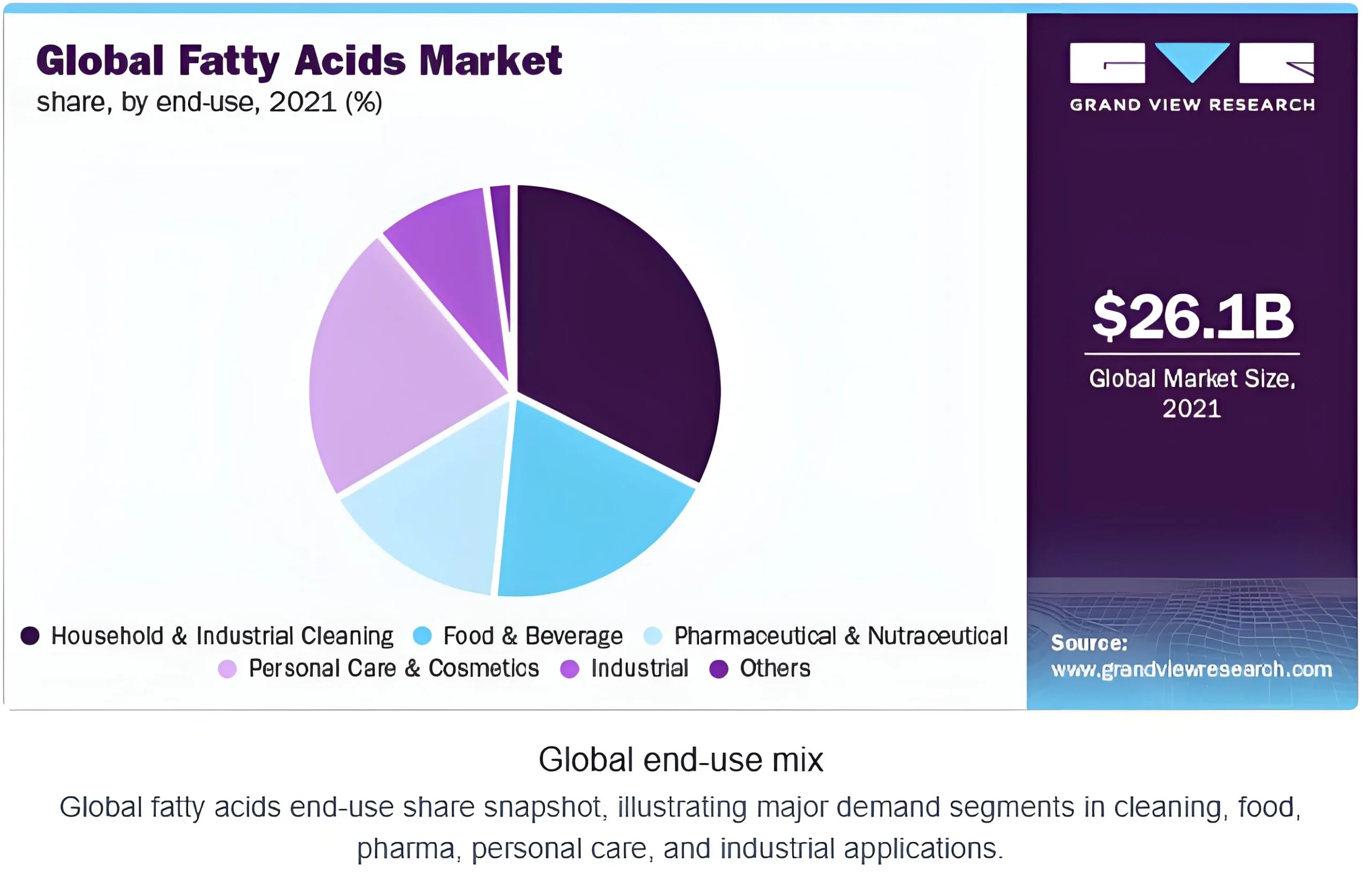
  • Soaps and detergents, personal care and cosmetics, industrial lubricants and surfactants
  • Resin modifiers, rubber, paints and coatings, and specialty chemicals

Market Size and Growth

Published estimates vary widely due to scope differences (coverage of derivatives, chain-length ranges, and inclusion of soap noodles or specialty esters). Recent sources place 2024–2025 market value in a band from roughly USD 22–33 billion, while some broad-scope reports cite over USD 100 billion when downstream derivatives are included. Typical reported CAGRs for 2025–2032 cluster around 4–6%.

Why It Matters

Fatty acids are foundational to consumer staples (cleaning, personal care, food), to bio-based chemicals substitution, and to low-carbon supply chains. The industry’s shift to sustainable sourcing and energy-efficient separation is reshaping cost curves and risk profiles for global brands.

Regional Landscape (Indicative)

지역Role in Market
아시아 태평양Largest producer and consumer
유럽Specialty grades, regulatory leadership
북미Mature demand, innovation clusters
Latin AmericaGrowing oleochemicals footprint
Middle East & AfricaEmerging consumption and logistics

Global Fatty Acids Market Size Forecast

II. Supply Chain Analysis

This section maps the fatty acids industry value chain end-to-end and pinpoints where value accrues and risks emerge.

1. Upstream: Feedstocks

  • Vegetable oils: palm, palm kernel, coconut, soybean, rapeseed; tall oil from pulping; used cooking oil in circular programs.
  • Animal fats: tallow, lard—used where specs allow.
  • Petrochemical routes: short-chain carboxylic acids; less common for C12–C18 volumes.
  • Pre-processing: degumming/neutralization, bleaching, winterization, deodorization; quality metrics include FFA, moisture, impurities, and color.

2. Midstream: Core Conversion and Separation

  • Hydrolysis (fat splitting) to produce mixed fatty acids and glycerin.
  • Hydrogenation for saturation control; isomerization where needed.
  • Fractional distillation and, for sensitive fractions, short-path/molecular distillation to isolate pure cuts (e.g., lauric C12, myristic C14, palmitic C16, stearic C18, oleic C18:1).
  • Intermediates: mixed fatty acids, distilled fatty acids, hydrogenated fatty acids, and downstream esters (e.g., isopropyl myristate).

  3. Downstream: Applications and Channels

  • Soaps and detergents, surfactants, personal care emollients and thickeners.
  • Food emulsifiers (through esters), nutraceuticals, and pharma excipients.
  • Lubricants, metalworking fluids, rubber activators, plasticizers, coatings.
  • Emerging uses: bioplastics, bio-lubricants, green solvents, agrochemicals.

Supply Chain Challenges and Practitioner Notes

  • Feedstock volatility: Palm and lauric oils are exposed to weather, policy, and biodiesel mandates; integrated producers actively hedge and diversify feedstock baskets, and dual-qualify recipes to maintain continuity.
  • Logistics: Liquid bulk coordination is critical—tank farm availability, ISO tank turnaround, and heating capabilities affect demurrage and product quality; during pandemic waves, we saw 2–4x lead-time spikes on certain lanes in Southeast Asia and EU.
  • Sustainability: RSPO-certified palm streams (segregated or mass-balance) are increasingly required by top-tier FMCG customers; traceability programs combine supplier scorecards, satellite land-use checks, and mill audits to satisfy brand and regulatory expectations (e.g., EU deforestation regulation).
  • Quality alignment: Food/pharma grades require tight peroxide, acid, and iodine values and robust change control; cross-contamination prevention and deodorization capacity are frequent bottlenecks when demand spikes.

III. Core Production Technologies (with Emphasis on Distillation)

This section explains the core production technologies, with a pragmatic focus on fractional distillation as the industry backbone.

Overview of Production Routes

  • Hydrolysis (fat splitting): Triglycerides react with water under high temperature and pressure to yield fatty acids and glycerin.
  • Hydrogenation: Adjusts saturation to meet performance or stability requirements.
  • Fractional distillation: Separates fatty acids by boiling point under deep vacuum.
  • Enzymatic methods: Low-temperature splitting using lipases for selective transformations; still niche but growing.

Fractional Distillation: Principle and Flow

  • 프로세스 흐름: Feed preheating → dehydration → vacuum column(s) with structured packing → side-draws by carbon number → polishing (short-path or reboiler trim) → deodorization/stripping → finishing tank.
  • Operating conditions: Deep vacuum (often below 5–10 mbar) lowers boiling points to protect color and limit cracking; columns frequently exceed 20–30 meters with high-efficiency packing.
  • Purity and specs: Commercial plants routinely deliver >95–98% single-cut purity; high-oleic or high-stearic specs are achievable with second-pass polishing.
  • 장점: High scalability, reliable cut consistency, broad feedstock tolerance, and proven quality control anchoring global standards.
  • Limitations: Energy intensity, high capex for tall columns, materials selection (316L/duplex) to manage corrosion for tall-oil and certain byproducts, and skilled operations for vacuum integrity.
  • Recent advances: Heat integration (multi-effect columns), mechanical vapor recompression on deodorization/stripping, advanced structured packing, model-predictive control for cut stability, and renewable steam or electrified reboilers to reduce Scope 1–2 emissions.

Practical Quality Control and Standardization

Routine analytics: GC-FID carbon-number profiling, acid value, iodine value, saponification value, color, peroxide value, odor threshold.

Standards and certifications: USP/NF and FCC for food/pharma, Kosher/Halal where applicable, ISO 9001/14001, and RSPO/ISCC for sustainable supply claims.

Comparison of Production Methods

방법Primary PurposeStrengthsConstraintsTypical Use-Cases
HydrolysisSplit triglyceridesMature, scalable, co-produces glycerinRequires energy and high-pressure kitBase step for most oleochemical plants
Fractional Distill.Purify by carbon numberHigh purity, flexible, industry standardEnergy and capex intensiveAll major single-cut fatty acid production
Short-path Distill.Gentle finishing/deodorizationLow thermal stress, protects colorLower throughputPremium grades, heat-sensitive fractions
HydrogenationSaturation adjustmentStability, custom melting profileCatalyst handling, selectivity controlStearic-rich or oxidative-stable grades
Enzymatic ProcessesSelective, low-temp conversionsSelectivity, potential lower footprintCost, enzyme lifetime, scale-upSpecialty esters, gentle splitting niches

Production Technology Market Share

Fractional Distillation Process Parameters

IV. Industry Trends and Challenges

Key Trends

  • Accelerating shift to bio-based and certified-sustainable fatty acids, driven by brand commitments and regulation; premium spreads for segregated palm streams are more accepted in tenders.
  • Asia-Pacific deepens its lead via integrated complexes and proximity to lauric feedstocks; Europe grows in high-purity and pharma-grade niches; North America focuses on process intensification and nearshoring resilience.
  • Technology progress in process intensification: better packing, advanced controls, heat pumps, and hybrid membrane–distillation pilots for specific cuts.

도전 과제

  • Raw material price volatility and policy shocks on edible oils; hedging and multi-feedstock qualification remain essential.
  • Environmental regulation, from carbon pricing to deforestation-free rules, adds compliance cost but favors transparent suppliers.
  • Supply chain disruptions from geopolitics and pandemics persist; tankage, vessel slots, and regional redundancy are key mitigations.

Brief Outlook

Expect steady mid-single-digit growth, with outsized gains in home and personal care, nutraceuticals, and bio-lubricants. The winners will combine assured sustainable feedstock access, energy-efficient distillation, and tight quality systems, while de-risking logistics and carbon exposure.

Global Fatty Acids Market Growth Forecast (2025-2032)

Segment Growth Index (2025=100)

관련 라이선스 기술 및 장비

화학 공정 솔루션

애플리케이션

지속 가능성

메시지 보내기

반응 및 분리 전문, 저탄소 기술 파트너

dodgen-chemical-process-company

문의하기

고객의 요구 사항을 충족하기 위해 최선을 다합니다.