Definición
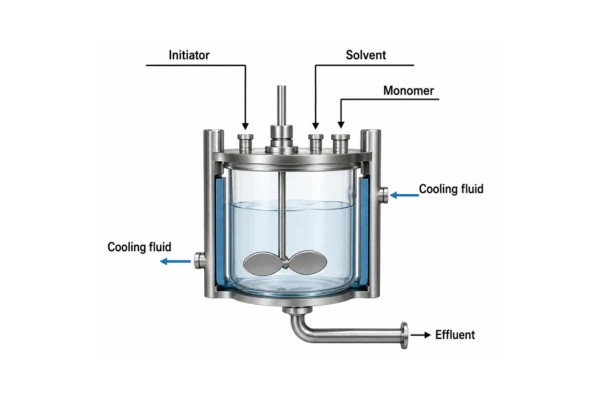
Solution polymerization is a polymer manufacturing process in which the monomer is dissolved in a suitable solvent before polymerization takes place. The reaction is initiated by heat or chemical initiators, with the solvent serving as the reaction medium to facilitate temperature control and heat removal.
Unlike bulk polymerization, solution polymerization benefits from the solvent’s ability to absorb and dissipate the heat generated during the reaction, making it easier to maintain stable operating conditions.
Principios fundamentales
In solution polymerization, both the monomer and initiator are mixed with a solvent before the reaction begins. Polymerization is typically carried out near the solvent’s reflux temperature, allowing the evaporation and condensation of the solvent to help remove reaction heat.
The final product depends largely on the solubility of the polymer in the chosen solvent.
- If the polymer remains soluble, the product is obtained as a polymer solution.
- If the polymer becomes insoluble during the reaction, it gradually precipitates from the solution, a process commonly known as precipitation polymerization.
Depending on the downstream process, the solvent may either be removed to recover the polymer or retained if the polymer solution itself is the desired product.
Ventajas
Solution polymerization offers several process advantages:
- Improved temperature control
- Efficient removal of reaction heat
- Lower reaction viscosity than bulk polymerization
- Better mixing performance
- Reduced risk of localized overheating
- Suitable for producing polymer solutions used directly in downstream applications
These characteristics make solution polymerization particularly attractive for reactions where heat management is critical.
Limitaciones
The use of solvents also introduces additional engineering considerations.
Compared with bulk polymerization, solution polymerization may result in:
- Lower molecular weight in some systems
- Additional solvent recovery requirements
- Higher downstream separation costs
- Increased process complexity
- Potential solvent compatibility and environmental considerations
The selection of an appropriate solvent is therefore an important factor affecting both product quality and process economics.
Aplicaciones industriales
Solution polymerization is widely used in the production of coatings, adhesives, synthetic resins, elastomers, and specialty polymers.
In some applications, the resulting polymer solution can be used directly without removing the solvent, such as in paints, coatings, and certain adhesive formulations. In other cases, the solvent is separated after polymerization to obtain the final polymer product.
The process is particularly suitable for manufacturing polymers that require effective temperature control or where solution-form products are preferred.
Consideraciones técnicas
One of the primary engineering challenges in solution polymerization is balancing reaction efficiency with solvent management.
Although solvents improve heat transfer and reduce reaction viscosity, they also increase separation requirements and operating costs. Engineers must carefully evaluate solvent selection, boiling point, polymer solubility, recovery efficiency, and environmental considerations during process design.
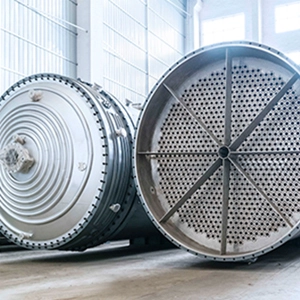
Many industrial solution polymerization systems integrate polymerization reactors, heat exchangers, distillation systems, y continuous processing technologies to improve heat management, solvent recovery, and production efficiency.
Términos relacionados
- Bulk Polymerization
- Suspension Polymerization
- Emulsion Polymerization
- Precipitation Polymerization
- Reactor de polimerización
- Intercambiador de calor
- Destilación