Definition
Cristalización is a separation process that utilizes differences in the solubility of one or more dissolved solids in a solvent to achieve purification or separation.
When the solubility of a target substance decreases under specific conditions, such as temperature reduction or solvent removal, crystals are formed and separated from the remaining liquid phase. Crystallization is widely used in chemical processing, salt production, pharmaceutical manufacturing, and advanced material purification.
Because the process can selectively separate desired compounds from impurities, crystallization remains one of the most important purification technologies in industrial production.
Basic Principle
The effectiveness of crystallization is based on differences in solubility.
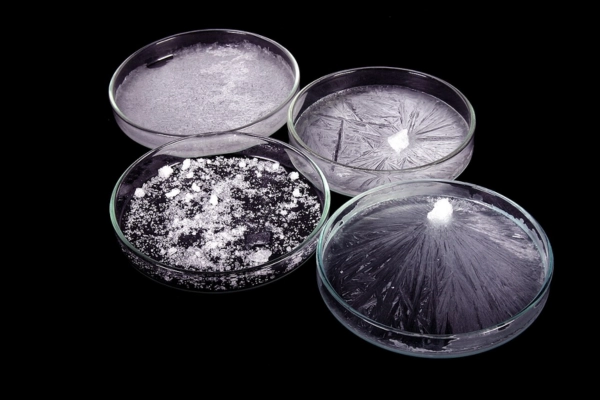
When a solution becomes supersaturated, dissolved substances begin to form solid crystals. These crystals can then be separated from the mother liquor, allowing the target material to be recovered with higher purity.
A common example is the separation of sodium chloride from impurities dissolved in seawater. By controlling process conditions, sodium chloride crystals can be formed while many impurities remain in solution.
Common Crystallization Methods
Several crystallization methods are used in industrial applications.
Cooling Crystallization
Cooling crystallization reduces the temperature of a solution, decreasing solubility and causing crystals to form.
This method is widely used when the target material exhibits strong temperature-dependent solubility.
Recrystallization
Recrystallization is primarily used for purification. Impure solids are dissolved and then crystallized again, allowing many contaminants to remain in the solution phase.
Evaporative Crystallization
Evaporative crystallization removes solvent through evaporation, increasing concentration until crystallization occurs.
This technique is commonly used in salt production and chemical manufacturing.
Sublimation Crystallization
Certain compounds can be purified through sublimation, where the material transitions directly between solid and vapor phases before reforming as purified crystals.
Industrial Relevance
Crystallization is one of the most widely used separation technologies in chemical manufacturing because it can simultaneously achieve product recovery and purification.
Industries commonly applying crystallization include:
- Specialty chemicals
- Química fina
- Inorganic salts
- Pharmaceutical intermediates
- Advanced materials
Compared with some thermal separation methods, crystallization can provide high product purity while helping reduce degradation of heat-sensitive materials.
Process Considerations
The performance of a crystallization process is influenced by several factors, including:
- Solubility behavior
- Tasa de enfriamiento
- Concentration
- Crystal growth conditions
- Impurity distribution
Poor process control may lead to irregular crystal size, reduced yield, or contamination of the final product.
For industrial facilities, achieving stable crystal growth and consistent product quality is often a primary operational objective.
Relationship to Industrial Purification Technologies
Crystallization is frequently integrated with other separation technologies, including evaporation, distillation, extraction, and filtration.
In advanced chemical manufacturing, crystallization systems are often used to produce high-purity products that cannot be economically purified through distillation alone.
Technologies such as melt crystallization have become particularly important for the purification of specialty chemicals, electronic materials, and high-value intermediates.
Related Terms
- Cristalización en fusión
- Recrystallization
- Evaporation
- Destilación
- Solubility
- Mother Liquor