Scaling MMA structural adhesive production from laboratory formulation work to industrial manufacturing rarely involves a simple increase in reactor volume. Many formulations that appear stable during pilot operation begin developing heat accumulation, viscosity instability, reactor fouling, VOC management problems, packaging inconsistency, and production downtime once throughput increases.
In industrial environments, polymerization control, heat transfer, devolatilization, environmental treatment, and downstream packaging become tightly interconnected operational systems. Problems that appear isolated during laboratory work often become amplified during continuous production campaigns where thermal behavior, material flow, and equipment performance influence each other simultaneously.
Many manufacturers eventually discover that stable MMA structural adhesive production depends less on isolated formulation optimization and more on the integration of reactor engineering, environmental systems, packaging stability, process controllability, and long-term operational consistency.
Why MMA Structural Adhesive Production Becomes Difficult During Scale-Up
MMA polymerization systems behave very differently once production enters industrial scale.
Laboratory reactors typically dissipate heat efficiently because the surface-area-to-volume ratio remains favorable. As reactor volume increases, however, heat removal efficiency declines while reaction mass increases substantially. This imbalance becomes increasingly difficult to control during high-conversion stages where viscosity rises rapidly and circulation efficiency begins deteriorating.
Some facilities discover that cooling performance starts declining long before temperature alarms activate, particularly after repeated production campaigns gradually reduce heat transfer efficiency along jacket surfaces because of polymer buildup and fouling accumulation.
Industrial MMA adhesive scale-up problems commonly include:
- Localized reactor hot spots
- Uneven molecular weight distribution
- Transfer line blockage
- Acumulación de vapor
- High-viscosity dead zones
- Gel particle formation
- Reactor wall deposition
- Packaging instability
- Batch-to-batch curing inconsistency
- Increasing cleaning frequency
These problems rarely remain independent. In many production environments, viscosity growth, vapor release, thermal instability, and downstream packaging issues begin amplifying one another once production throughput increases beyond pilot-scale conditions.
Polymerization Systems Used in Industrial MMA Adhesive Manufacturing
Industrial MMA structural adhesive production commonly relies on batch reactors, semi-batch systems, or continuous polymerization systems depending on formulation flexibility, throughput targets, and operational strategy.
Batch Polymerization Systems
Batch reactors remain widely used because they simplify formulation changes and support specialty adhesive manufacturing.
Las configuraciones industriales típicas incluyen:
- Jacketed stainless steel reactors
- Anchor or helical ribbon agitators
- External recirculation loops
- Metered initiator feeding systems
- Nitrogen blanketing systems
- Vacuum devolatilization units
- Condensation recovery systems
Batch systems provide operational flexibility, but large-scale thermal stability becomes increasingly difficult once viscosity begins escalating during late-stage conversion.
Some operators first notice instability indirectly through gradual agitator torque increase and slower circulation response rather than through immediate reactor temperature deviation.
Polymer accumulation near agitator shafts, baffles, and lower vessel corners may progressively reduce mixing efficiency after repeated campaigns, particularly in high-solids MMA adhesive formulations operating above 60–70% solids content.
Semi-Batch Polymerization Systems
Semi-batch operation is widely used to improve thermal controllability during highly exothermic MMA polymerization.
Gradual monomer and initiator feeding helps reduce sudden heat release while improving molecular weight consistency and minimizing localized overreaction.
In some production systems, staged initiator dosing is specifically implemented to avoid radical concentration spikes near feed injection zones where polymer growth may otherwise accelerate uncontrollably.
Semi-batch systems also help manufacturers better manage:
- Heat accumulation
- Vapor release
- Reaction rate stability
- Viscosity escalation
- Gel formation risk
- Mixing controllability
However, feeding strategy optimization becomes increasingly sensitive during industrial scale-up. Minor deviations in feed timing or flow balance that remain insignificant in pilot reactors may create major thermal imbalance once reactor diameter and batch mass increase.
Continuous Flow Polymerization Systems
Continuous polymerization systems are increasingly adopted for large-scale MMA adhesive manufacturing because they improve throughput consistency and automation compatibility.
Continuous systems can provide:
- Stable residence time distribution
- Improved thermal transfer
- Reduced batch variability
- Lower labor dependency
- More consistent product quality
- Higher long-term production efficiency
However, continuous manufacturing introduces operational problems that are often underestimated during early process development.
Reactor fouling remains one of the most important industrial limitations. Polymer deposition may gradually form near feed injection zones, static mixing sections, reactor bends, and poorly flushed surfaces where localized thermal accumulation accelerates unwanted polymer growth.
Some manufacturers initially transition toward continuous operation expecting lower labor intensity, only to later encounter increasing shutdown frequency caused by fouling buildup and extended cleaning cycles.
Long-duration production campaigns may also introduce:
- Seal wear
- Inline filter blockage
- Pressure fluctuation
- Static mixer clogging
- Product transition contamination
- Startup scrap generation
Packaging and downstream operations often become increasingly sensitive once continuous polymerization systems operate near maximum throughput capacity.
Controlling Heat and Viscosity During Large-Scale MMA Polymerization
Thermal management remains one of the most critical engineering problems in industrial MMA structural adhesive production.
MMA free-radical polymerization generates substantial heat. As polymer conversion increases, viscosity rises rapidly, reducing circulation efficiency and slowing heat transfer across reactor surfaces.
This behavior becomes especially problematic inside large-volume reactors where localized hot spots may develop faster than bulk temperature sensors can detect them.
Heat Accumulation and Runaway Risk
Industrial MMA polymerization systems commonly operate between 70°C and 120°C depending on initiator chemistry, solids loading, and reactor configuration.
Some high-solids MMA adhesive systems may experience viscosity escalation above 40,000–80,000 cP during late-stage conversion, significantly reducing effective mixing efficiency and thermal transfer performance.
In certain production campaigns, operators observe that cooling water fluctuations during summer operation can destabilize reactor temperature control more severely than expected because elevated ambient conditions simultaneously affect cooling efficiency, vapor pressure, and viscosity behavior.
As thermal transfer efficiency declines, plants may experience:
- Runaway polymerization
- Sudden vapor release
- Reactor overpressure
- Product discoloration
- Molecular weight instability
- Premature gelation
- Pressure relief activation
Industrial facilities often combine multiple cooling strategies simultaneously, including:
- Jacket cooling
- Internal cooling coils
- External recirculation heat exchangers
- Feed-rate reduction systems
- Emergency quench systems
- Automated interlock shutdown systems
Some plants discover that thermal instability begins developing gradually near wall-side stagnant regions long before overall reactor temperature appears abnormal on centralized control systems.
Viscosity Growth and Mixing Limitations
High-viscosity MMA adhesive systems place heavy mechanical loads on pumps, seals, agitators, and transfer systems.
Some facilities observe progressive cavity pump torque rising sharply during late-stage polymer transfer, particularly when seasonal ambient temperature shifts accelerate viscosity drift between reactor discharge and packaging operations.
High-viscosity behavior may also reduce flow uniformity inside transfer lines, causing localized stagnation zones where premature polymer buildup gradually narrows pipe diameter over extended production campaigns.
Industrial viscosity management strategies commonly include:
- Variable-speed agitation systems
- Progressive cavity pumps
- Heated transfer piping
- Inline viscosity monitoring
- Torque monitoring systems
- Multi-stage mixing systems
Some manufacturers additionally redesign agitator geometry and vessel internals specifically to reduce dead zones during high-solids operation.
Reactor Fouling, Cleaning Cycles, and Production Downtime
Reactor fouling remains one of the most underestimated cost drivers in MMA adhesive manufacturing.
Polymer deposition may gradually accumulate along:
- Reactor walls
- Feed injection points
- Cooling jackets
- Mezcladoras estáticas
- Transfer piping
- Vent systems
- Heat exchangers
Operators sometimes first identify fouling indirectly through rising circulation pressure and declining heat transfer efficiency rather than visible polymer buildup.
As fouling accumulates, plants may experience:
- Higher pressure drop
- Reduced thermal transfer
- Longer startup stabilization
- Increased cleaning downtime
- Reduced throughput consistency
- Rising energy consumption
Cleaning strategy therefore becomes a major operational trade-off.
Aggressive solvent flushing may improve cleaning efficiency while simultaneously increasing VOC generation, wastewater treatment load, and solvent recovery requirements.
Some facilities optimize cleaning intervals based on gradual pressure-drop trends rather than fixed maintenance schedules in order to reduce unnecessary shutdown frequency.
VOC Emissions and Environmental Control Systems
VOC management has become a major operational priority in industrial MMA adhesive manufacturing because MMA monomer possesses strong volatility and odor characteristics.
VOC emissions commonly occur during:
- Monomer unloading
- Reactor charging
- Desvolatilización al vacío
- Reactor venting
- Tank breathing
- Transfer operations
- Packaging transfer
- Equipment cleaning
- Storage operations
In many plants, emission peaks occur during startup, shutdown, cleaning, and maintenance operations rather than during stable polymerization itself.
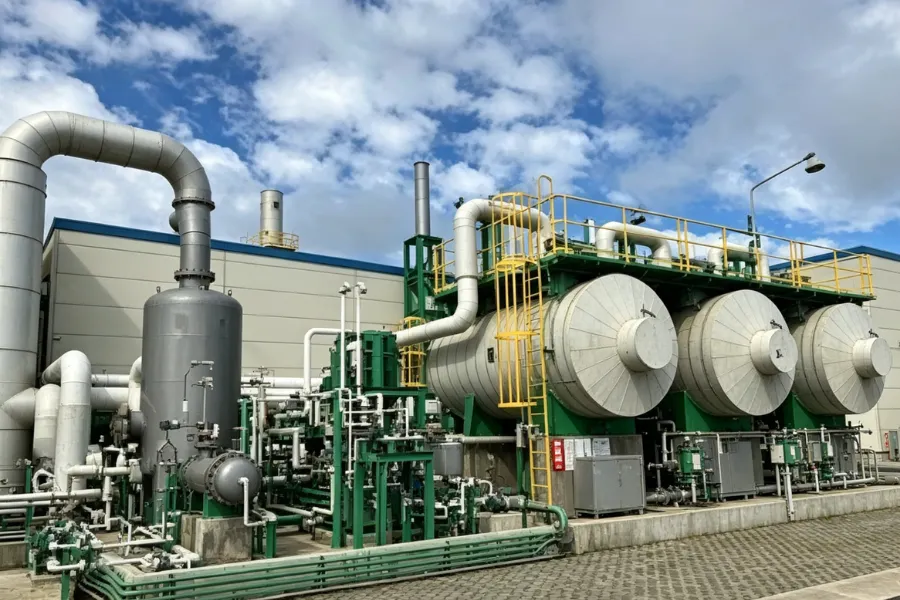
Activated Carbon Adsorption Systems
Activated carbon adsorption remains widely used for low-concentration MMA vapor treatment because of its relatively high removal efficiency and operational simplicity.
Fiber-based activated carbon systems are sometimes preferred because they provide:
- Faster adsorption kinetics
- Lower pressure drop
- Improved regeneration efficiency
However, adsorption systems require careful operational monitoring.
Some adhesive plants discover activated carbon replacement intervals shorten significantly during summer production peaks when reactor vent temperatures rise and MMA vapor loading increases unexpectedly.
In facilities operating multiple production lines simultaneously, adsorption bed saturation may become increasingly uneven depending on campaign scheduling and packaging activity.
Condensation Recovery Systems
Condensation recovery systems are widely used to recover MMA vapor before secondary treatment stages.
Typical recovery applications include:
- Reactor vent streams
- Vacuum stripping systems
- Packaging exhaust systems
- Storage tank vapor balancing systems
Low-temperature condensation systems can significantly reduce monomer loss while lowering downstream adsorption load and improving overall solvent recovery economics.
Catalytic Oxidation Systems
Catalytic oxidation systems are often selected for continuous exhaust streams containing relatively low VOC concentrations.
These systems convert VOCs into CO₂ and H₂O under controlled operating conditions while consuming less energy than conventional thermal oxidation systems.
However, catalyst deactivation remains a significant operational issue when sulfur-containing contaminants, degraded additives, or particulate residues enter the exhaust stream over long operating periods.
Wastewater, Solvent Recovery, and Environmental Compliance
Industrial MMA adhesive plants may generate wastewater containing:
- Residual monomers
- Cleaning solvents
- Polymer residues
- Surfactants
- Organic additives
- Suspended solids
Wastewater COD levels often rise sharply during reactor cleaning campaigns, packaging line flushing, and maintenance shutdowns.
Some facilities observe that cleaning wastewater volume increases substantially after prolonged production campaigns because higher fouling accumulation requires more aggressive flushing procedures.
Industrial treatment systems commonly combine:
- Physical separation
- Chemical oxidation
- Biological treatment
- Membrane filtration
- Solvent recovery systems
Increasingly strict environmental regulations are also pushing manufacturers toward closed-loop solvent recovery and water reuse systems to reduce both operating cost and discharge burden.
Packaging Challenges for MMA Structural Adhesives
Packaging stability becomes increasingly important once MMA adhesive products enter large-scale transportation and distribution systems.
Residual monomer vapor, oxygen ingress, temperature cycling, and initiator stability may all influence long-term storage performance.
Common Industrial Packaging Formats
MMA structural adhesives are commonly packaged in:
- Dual cartridges
- Bulk drums
- Pails
- Flexible liners
- Intermediate bulk containers
Packaging Stability Risks
Industrial packaging problems may include:
- Cartridge deformation
- Pressure swelling
- Seal leakage
- Moisture ingress
- Vapor permeation
- Phase separation
- Liner degradation
- Initiator migration
Some adhesive manufacturers encounter unexpected package swelling during summer transportation when residual monomer vapor interacts with liner materials originally validated only under laboratory storage conditions.
Packaging technicians sometimes identify pressure instability during filling operations long before laboratory residual monomer analysis confirms devolatilization imbalance upstream.
Packaging Line Integration and Operational Stability
Packaging systems must remain synchronized with upstream polymer production to avoid material stagnation and curing inconsistency.
Operational problems commonly emerge when:
- Filling speed fluctuates
- Cartridge air entrapment increases
- Static mixers begin clogging
- Material residence time extends excessively
- Packaging line stoppages interrupt downstream flow
Some facilities eventually discover that packaging reject rates correlate more strongly with upstream viscosity drift and devolatilization inconsistency than with filling equipment performance itself.
Worker Safety and EHS Considerations
Industrial MMA adhesive manufacturing involves multiple EHS risks associated with flammability, peroxide handling, vapor exposure, and exothermic polymerization.
Critical industrial safety systems commonly include:
- Explosion-proof electrical systems
- Nitrogen blanketing
- VOC monitoring systems
- Ventilation systems
- Static discharge prevention
- Pressure relief systems
- Emergency cooling systems
- Spill containment systems
- Automated shutdown logic
Organic peroxide initiators require particularly strict storage control because thermal decomposition may occur if temperature stability deteriorates.
Worker exposure risk often increases during:
- Manual charging
- Reactor sampling
- Cleaning operations
- Packaging transfer
- Equipment flushing
- Maintenance shutdowns
Many modern facilities increasingly automate these operations to simultaneously reduce operator exposure, improve process consistency, and minimize production variability.
Process Optimization Strategies for Stable Industrial MMA Adhesive Production
As production scale increases, process optimization becomes essential for maintaining both operational reliability and product consistency.
Modern MMA adhesive plants increasingly integrate:
- Inline viscosity monitoring
- Automated feed control
- Closed-loop temperature systems
- Real-time VOC monitoring
- Predictive maintenance systems
- Digital process control
- Heat integration systems
- Automated cleaning cycles
- Continuous quality monitoring
Some manufacturers also adopt modular reactor configurations because multiple smaller production units may provide better thermal controllability and maintenance flexibility than extremely large single-reactor systems.
In practice, stable MMA structural adhesive manufacturing requires far more than successful polymer chemistry alone. Long-term industrial reliability increasingly depends on integrating polymerization control, environmental engineering, thermal management, packaging stability, operational consistency, and process scalability into a unified manufacturing system.
DODGEN focuses on scalable chemical process engineering solutions that support industrial polymer and adhesive manufacturers in improving process stability, environmental performance, and long-term production reliability across complex industrial manufacturing environments.
Conclusión
As MMA structural adhesive demand continues expanding across automotive, transportation, construction, electronics, and composite manufacturing industries, production systems are facing increasing pressure to improve throughput, environmental compliance, process controllability, and operational consistency simultaneously.
Manufacturers that successfully integrate polymerization control, VOC recovery, reactor stability, packaging engineering, thermal management, and long-term operational reliability will be better positioned to maintain efficient industrial production under increasingly demanding commercial and regulatory conditions.