Definición
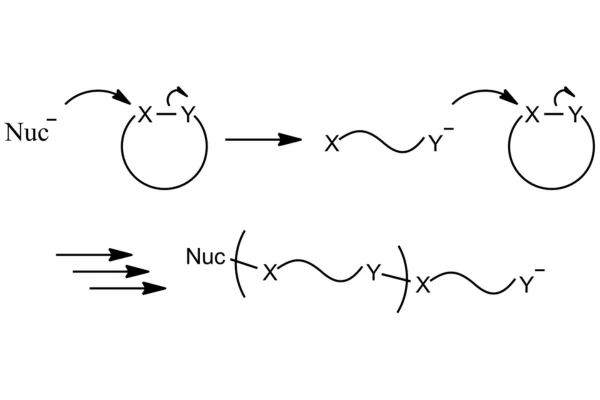
Ring-opening polymerization (ROP) is a polymerization process in which cyclic monomers undergo ring opening in the presence of an initiator or catalyst to form linear polymer chains. Unlike conventional addition polymerization, ring-opening polymerization converts the ring structure of the monomer into a growing polymer backbone while retaining most of the original atoms within the polymer chain.
By incorporating heteroatoms such as oxygen (O), nitrogen (N), or sulfur (S) into the polymer backbone, ring-opening polymerization enables the production of polymers with properties that are difficult to achieve through conventional polymerization methods.
Reaction Mechanisms
Ring-opening polymerization may proceed through several different reaction mechanisms, depending on the catalyst system and monomer structure.
The three most common mechanisms are:
- Anionic Ring-Opening Polymerization
- Cationic Ring-Opening Polymerization
- Coordination Ring-Opening Polymerization
The choice of mechanism influences reaction rate, molecular weight control, polymer architecture, and final material properties.
Typical Monomers
Many cyclic compounds can undergo ring-opening polymerization.
Common industrial monomers include:
- Epoxides
- Lactones
- Lactams
- Cyclic sulfides
Commercially important examples include ethylene oxide, propylene oxide, ε-caprolactam, and trioxane, all of which are widely used in industrial polymer manufacturing.
Importancia industrial
Ring-opening polymerization is an important process technology for producing high-performance polymers with well-controlled molecular structures.
Because the reaction introduces heteroatoms into the polymer backbone, it is widely used to manufacture engineering plastics, biodegradable polymers, specialty elastomers, and advanced functional materials.
Industrial applications include the production of:
- Ácido poliláctico (PLA)
- Polyglycolic acid (PGA)
- Polyoxymethylene (POM)
- Polyethers
- Polyamides
Many of these materials are used in medical devices, packaging, automotive components, electronics, and sustainable materials.
Consideraciones técnicas
Successful ring-opening polymerization depends on precise control of reaction conditions throughout the process.
Los ingenieros suelen evaluar:
- Catalyst selection
- Monomer purity
- Moisture control
- Reaction temperature
- Tiempo de residencia
- Molecular weight control
- Heat removal capability
Many cyclic monomers are sensitive to impurities such as water or oxygen, making feedstock purification an important factor in achieving consistent polymer quality.
As polymer chains grow, viscosity may increase significantly, requiring efficient mixing and heat transfer to maintain stable operating conditions.
Continuous flow reactors and polymerization reactors are increasingly adopted for ring-opening polymerization because they provide improved temperature control, enhanced safety, and more consistent product quality compared with conventional batch processing.
Tecnologías relacionadas
Ring-opening polymerization is closely associated with several other process technologies, including:
- Polimerización
- Reactor de flujo continuo
- Reactor de polimerización
- Mezclador estático
- Intercambiador de calor
- Tiempo de permanencia