Why Pharmaceutical-Grade Isosorbide Requires Ultra-High Purity
Pharmaceutical-grade material is required to meet purity levels above 99.5 percent, as defined by pharmacopeial standards and downstream application requirements. These specifications are driven by the sensitivity of drug formulations and polymer systems to trace components.
Residual compounds, including sorbitol, sorbitan isomers, and thermal degradation products, can affect stability, color, and biological response. In nitrate-based formulations, impurity profiles may influence side effect intensity and therapeutic consistency.
Product quality therefore functions as a control variable for both safety and performance, rather than a secondary attribute.
Where Impurities in Isosorbide Come From and Why They Are Difficult to Remove
The target material is produced through dehydration of sorbitol, where multiple parallel and sequential reactions occur under elevated temperature conditions. This pathway generates structurally similar by-product species such as 1,4-sorbitan and 2,5-sorbitan, along with unreacted intermediates.
These residual components present a separation challenge due to their close boiling points and similar molecular structures. Conventional phase separation techniques lack sufficient selectivity to isolate pharmaceutical-grade output.
The separation difficulty is therefore driven by molecular similarity rather than concentration.
Why Conventional Purification Methods Cannot Achieve Pharmaceutical Standards
| Método | Limitation |
|---|---|
| Destilación | Limited separation of structurally similar compounds, high thermal load |
| Cristalización con disolventes | Residual solvent risk, solubility constraints |
| Liquid extraction | High solvent consumption, environmental and cost impact |
Distillation operates at elevated temperatures, which may induce degradation and color formation. Solvent-based crystal formation introduces additional contamination risks and requires solvent recovery systems.
None of these methods provide sufficient selectivity for removing structurally similar compounds without compromising yield or introducing secondary process risks.
How Crystallization Determines Final Product Purity
The crystal formation process defines the final quality level by controlling phase transition behavior and impurity rejection mechanisms. Unlike distillation, which relies on volatility differences, solid-phase separation leverages thermodynamic stability differences between phases.
Quality enhancement is governed by two key mechanisms:
- Controlled supersaturation, which determines nucleation selectivity
- Crystal growth kinetics, which influence exclusion of unwanted compounds
Residual species are rejected either into the mother phase or through controlled removal from the crystal layer. The effectiveness of this rejection depends on temperature gradients, cooling rates, and residence time.
This process therefore functions as a selective separation step rather than a simple phase change.
Advanced Crystallization Technologies Used in the Production Process
How Melt Crystallization Achieves High-Purity Separation
Melt-based crystal processing operates without solvents and relies on differences in melting behavior between the target material and residual components. The process typically includes:
- Controlled cooling to form a crystalline layer
- Drainage of impurity-rich melt
- Sweating stage, where gradual heating removes entrapped compounds
- Final melting to recover refined product
This approach achieves pharmaceutical-grade quality starting from feed streams in the 95 to 97 percent range. The absence of solvents eliminates contamination risks and reduces downstream processing requirements.
Temperature control during the sweating stage determines removal efficiency.
Why Continuous Crystallization Improves Process Stability
Continuous crystal processing systems, including stirred tank reactors and multi-stage cascades, operate under steady-state conditions. These systems provide:
- Consistent particle size distribution
- Improved filtration and washing performance
- Stable process control for large-scale production
Multi-stage configurations enhance separation efficiency by progressively increasing quality across each stage. Industrial systems may integrate multiple units depending on target specifications.
Steady-state operation reduces variability and improves reproducibility.
When Sublimation Crystallization Is Used for Final Purification
Sublimation-based refinement provides a solvent-free route for high-purity processing by enabling direct solid-to-vapor-to-solid transitions. This method avoids liquid-phase intermediates and minimizes degradation under reduced pressure conditions.
It is typically applied in:
- High-value, small-scale purification
- Final polishing stages for ultra-high quality output
Industrial application is limited by throughput and energy considerations.
How Post-Crystallization Processing Affects Final Purity
Post-processing operations influence final quality, yield, and contamination risk. Traditional workflows involve multiple transfer steps between filtration, washing, and drying units, introducing handling losses.
Integrated systems combine:
- Solid-liquid separation
- Surface washing
- Centrifugal drying
Processing within a single enclosed unit reduces contamination risk and improves washing uniformity. Controlled washing removes residual mother phase and surface impurities.
System configuration directly affects recovery rate and compliance.
What Industrial Data Shows About Purity Improvement
Industrial systems demonstrate measurable improvements in quality and impurity reduction:
- Feed quality of 95 to 97 percent can be increased to 99.5 to 99.9 percent
- Structural by-products are significantly reduced
- Optical properties improve, including higher transmittance for polymer applications
Process design is supported by solubility data and kinetic modeling. These models enable prediction of crystal growth behavior and scale-up performance.
Performance is defined by the relationship between quality, yield, and energy input.
How to Design an Integrated Isosorbide Purification Process
High-quality production requires integration of multiple process stages rather than reliance on a single operation. A typical configuration includes:
- Pre-concentration through distillation
- Multi-stage crystal processing for impurity rejection
- Integrated solid handling for product recovery
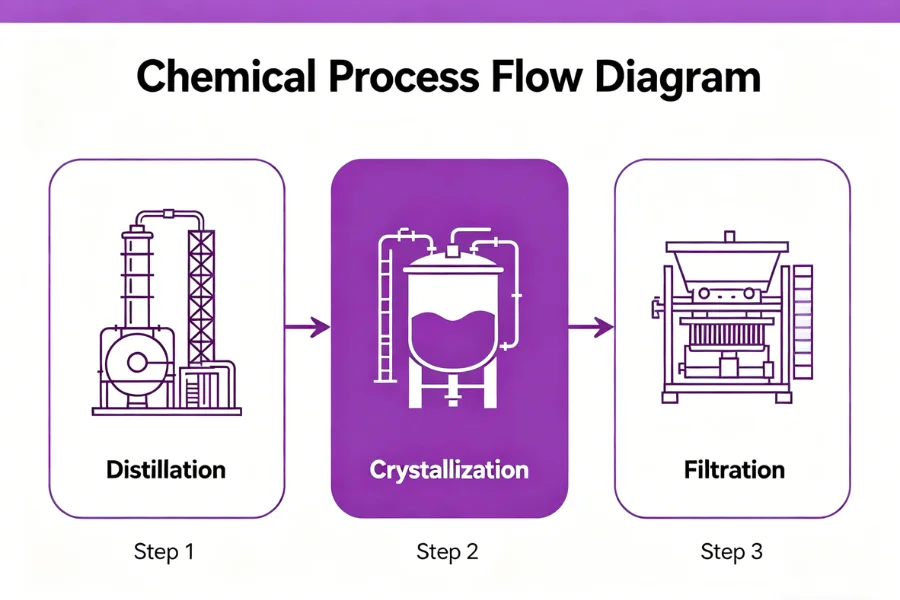
System-level design determines process stability, scalability, and compliance.
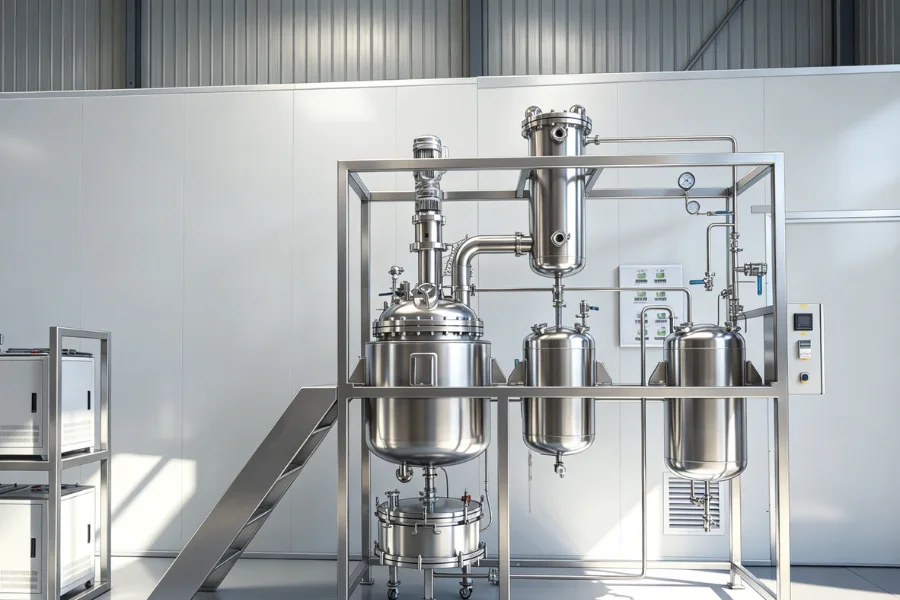
Industrial configurations implemented by DODGEN apply controlled temperature profiles, staged separation, and integrated post-processing to achieve consistent output under GMP conditions.
The focus remains on process control and reproducibility.
Key Takeaways on Achieving High-Purity Isosorbide at Scale
Quality in pharmaceutical production is determined at the crystal processing stage, where phase behavior and impurity rejection define final output.
Advanced systems function as separation engines that leverage thermodynamic and kinetic control to achieve high selectivity. Melt-based processing, continuous operation, and integrated handling form a unified approach for industrial-scale purification.
Process integration defines the ability to consistently achieve pharmaceutical-grade output.