Definición
Bulk polymerization, also known as mass polymerization, is a polymer production process in which the monomer polymerizes without the addition of solvents or dispersion media. Under the influence of heat, light, radiation, or chemical initiators, the monomer undergoes polymerization directly to form the desired polymer.
Depending on the mutual solubility of the monomer and the resulting polymer, bulk polymerization may proceed as either a homogeneous o heterogeneous system during the reaction.
Principios fundamentales
The distinguishing feature of bulk polymerization is its simple reaction system. Since the reaction mixture primarily consists of monomer and the growing polymer chains, the final product generally contains very few impurities and requires minimal downstream separation.
As polymerization progresses, however, the reaction mixture becomes increasingly viscous. This change in viscosity reduces heat transfer efficiency and makes it more difficult to remove the heat generated by the reaction, requiring careful control of reaction conditions.
Ventajas
Bulk polymerization offers several important benefits:
- High product purity due to the absence of solvents
- Simple process configuration
- Minimal post-treatment and solvent recovery
- Suitable for producing transparent and high-performance polymers
- Lower risk of solvent contamination
These advantages make the process attractive for applications where product purity and optical quality are important.
Limitaciones
Despite its simplicity, bulk polymerization presents several engineering challenges.
As viscosity increases during polymerization, heat dissipation becomes more difficult, increasing the possibility of localized overheating and uneven reaction conditions. These factors may lead to:
- Slower reaction rates
- Non-uniform molecular weight distribution
- More demanding temperature control
- Reduced mixing efficiency at high conversion
Effective reactor design and heat removal are therefore critical to maintaining stable product quality.
Aplicaciones industriales
Bulk polymerization is widely used to manufacture polymers that require high optical clarity or high purity.
Typical products include:
- Polystyrene (PS)
- Polymethyl methacrylate (PMMA or acrylic)
- Optical-grade polymer materials
- Specialty engineering plastics
Because no solvent removal step is required, bulk polymerization is particularly suitable for products where residual impurities must be minimized.
Consideraciones técnicas
For process engineers, the primary challenge in bulk polymerization is balancing reaction efficiency with heat removal.
As viscosity rises throughout the reaction, conventional mixing methods become less effective. Reactor selection, heat transfer performance, and temperature control therefore play a significant role in achieving consistent polymer quality.
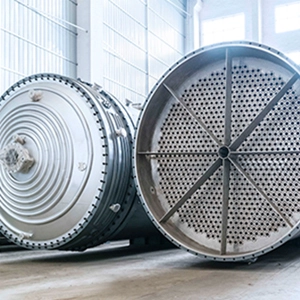
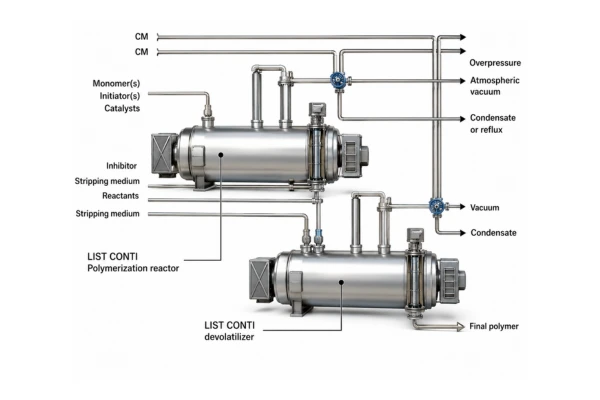
Many modern polymer production facilities employ specialized polymerization reactors, efficient heat exchangers, and continuous process technologies to improve temperature control and reduce the risk of thermal runaway during high-conversion polymerization.
Términos relacionados
- Polimerización
- Solution Polymerization
- Suspension Polymerization
- Emulsion Polymerization
- Reactor de polimerización
- Intercambiador de calor
- Reactor de flujo continuo