정의
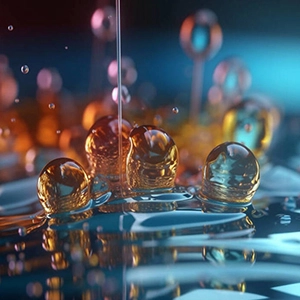
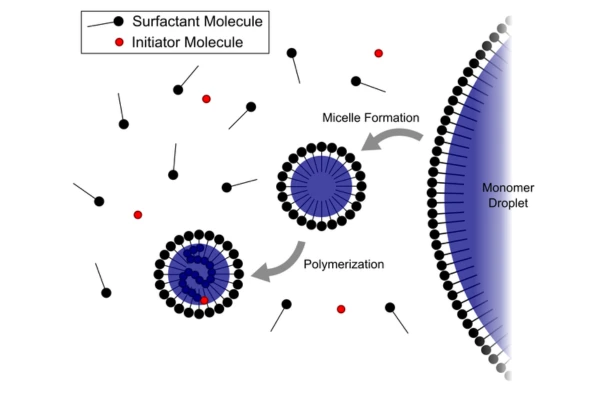
Emulsion polymerization is a polymer manufacturing process in which water-insoluble monomers are dispersed in water with the aid of surfactants (emulsifiers) and polymerized under mechanical agitation. Polymerization occurs within finely dispersed droplets or micelles, producing a stable polymer latex.
Compared with other polymerization methods, emulsion polymerization offers efficient heat dissipation, high polymerization rates, and the ability to produce high-molecular-weight polymers under relatively mild reaction conditions.
Core Principles
In emulsion polymerization, monomers are dispersed in water with surfactants to form an emulsion. Polymerization is initiated by suitable initiators, while continuous mixing maintains the stability of the reaction system.
Because water serves as the continuous phase, the heat generated during polymerization can be removed more efficiently than in bulk polymerization. This improves temperature control and helps maintain stable reaction conditions.
Depending on downstream processing requirements, the resulting polymer latex may be used directly or further processed to recover the solid polymer.
장점
Emulsion polymerization provides several important process advantages:
- Excellent heat removal during polymerization
- Faster polymerization rates
- Production of high-molecular-weight polymers
- Lower reaction viscosity than bulk polymerization
- Stable polymer latex suitable for direct application in some products
These characteristics make the process well suited for large-scale industrial polymer production.
제한 사항
Despite its advantages, emulsion polymerization also presents several engineering considerations.
Typical limitations include:
- Residual surfactants and additives may remain in the final product
- Additional purification or coagulation steps may be required
- Product properties depend on emulsion stability
- Wastewater and process water require appropriate treatment
Careful control of emulsifier concentration, particle stability, and reaction conditions is essential for consistent product quality.
산업 분야 적용
Emulsion polymerization is widely used in the production of synthetic rubber, synthetic resins, latex coatings, pressure-sensitive adhesives, and various polymer dispersions.
Common monomer systems include styrene, butadiene, vinyl chloride, chloroprene, and other vinyl monomers.
Stable polymer latexes may be used directly in applications such as:
- Paints and coatings
- Textile finishing
- Adhesives
- Paper coatings
- Surface treatment materials
Alternatively, the polymer can be recovered through coagulation, centrifugation, spray drying, or other separation methods when a dry polymer product is required.
엔지니어링 고려 사항
Successful emulsion polymerization depends not only on reaction kinetics but also on maintaining a stable emulsion throughout the process.
Engineers typically evaluate surfactant selection, particle size distribution, mixing intensity, heat removal, and latex stability when designing industrial systems. During downstream processing, separation technologies such as centrifugation, drying, and coagulation play important roles in determining final product quality and production efficiency.
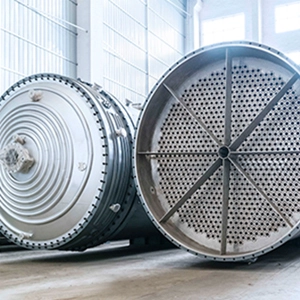
Many industrial emulsion polymerization plants integrate polymerization reactors, heat exchangers, 및 separation equipment to improve process control, product consistency, and overall manufacturing efficiency.