정의
정의
A plate heat exchanger (PHE) is a type of heat transfer equipment that uses a series of thin metal plates to transfer heat between two fluids. The plates are arranged to form alternating flow channels, allowing hot and cold fluids to exchange heat efficiently without direct contact.
Compared with traditional shell-and-tube heat exchangers, plate heat exchangers provide a much larger heat transfer surface within a compact footprint, making them widely used in chemical processing, food production, pharmaceuticals, HVAC systems, and energy recovery applications.
Types of Plate Heat Exchangers
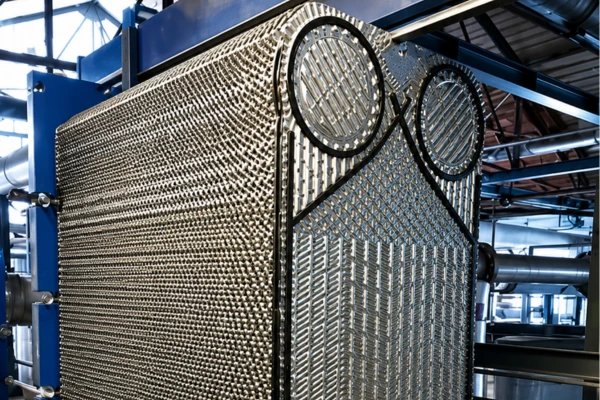
Plate heat exchangers are generally classified into three main types:
- Gasketed Plate Heat Exchangers – Plates are sealed with gaskets, allowing the unit to be disassembled for cleaning, maintenance, or capacity expansion.
- Brazed Plate Heat Exchangers – Plates are permanently joined by brazing, providing a compact design suitable for refrigeration and HVAC applications.
- Welded Plate Heat Exchangers – Plates are welded together to withstand higher temperatures, pressures, and aggressive process fluids.
The appropriate design depends on operating conditions, maintenance requirements, and process media.
How It Works
Inside a plate heat exchanger, adjacent flow channels carry hot and cold fluids separately. The corrugated plate surfaces generate turbulence, improving heat transfer while maintaining separation between the two fluids.
Heat passes through the thin metal plates from the hot stream to the cold stream without mixing the fluids. This arrangement enables efficient thermal exchange with relatively low energy consumption.
장점과 한계
장점
- High heat transfer efficiency
- Compact equipment design
- Large heat transfer area
- Easy maintenance for gasketed designs
- Flexible capacity adjustment by adding or removing plates
제한 사항
- Higher sealing requirements
- Thin plates may be sensitive to mechanical damage
- Excessive pressure differences between fluids should be avoided
- Some designs are less suitable for heavily fouling or highly viscous fluids
산업 분야 적용
Plate heat exchangers are widely used in industrial heat transfer operations, including:
- Heating and cooling of process fluids
- Condensation and evaporation
- Waste heat recovery
- Chemical process temperature control
- 식음료 가공
- 의약품 제조
- HVAC systems
In chemical plants, plate heat exchangers are commonly integrated into continuous processing systems where stable temperature control directly affects reaction efficiency and product quality.
엔지니어링 고려 사항
When selecting a plate heat exchanger, engineers typically evaluate:
- Heat transfer duty
- 작동 압력 및 온도
- 유체의 물성
- 오염 경향
- 내식성
- 압력 강하
- 유지보수 접근성
Material selection is equally important. Stainless steel plates are commonly used for corrosion resistance, while gasket materials must be compatible with the process fluid and operating temperature.
관련 용어
- 열교환기
- Shell and Tube Heat Exchanger
- 정적 믹서
- 연속 흐름 반응기
- 열전달