In typical reactions such as etherification, esterification, and hydrogenation, traditional processes usually face three common bottlenecks:
(1) Due to balance constraints, the conversion rate cannot be further increased;
(2) Strong heat release leads to hotspots and side reactions;
(3) The equipment chain is long, energy consumption is high, and the investment and operation and maintenance costs are also high.
As a typical 프로세스 강화 technology, Reactive Distillation (RD) integrates reaction and separation into a single column and continues to gain momentum in industrial applications through synergistic effects. On the one hand, RD removes products in situ, thereby overcoming equilibrium limitations; on the other hand, it utilizes the latent heat of phase change to dissipate reaction heat and enables a more stable, near-isothermal operation. As a result, RD improves yield, reduces energy consumption, 및 significantly shortens the process flowsheet and capital investment.
However, industry competition is evolving. In the early stage, the key question was simply whether a supplier “had reactive distillation.” Today, customers place greater emphasis on whether you can provide systematic delivery capabilities—from core catalytic structured packing, to a column internals platform, and further to process packages, catalyst systems, and scale-up execution. Against this backdrop, we select several representative international players and benchmark them alongside 도겐, taking a user-centric perspective.
Based on this background, from a customer’s perspective, 도겐 benchmarks several representative international players.
Two Global Benchmark Brands: “RD Catalytic Structured Packing” from Sulzer and Koch-Glitsch
In the most critical link—catalytic structured packing (the core component of RD)—the two most frequently cited global brands are Sulzer Chemtech 그리고 Koch-Glitsch.
Sulzer’s core product is Katapak™, which integrates a structured mass-transfer geometry with a catalyst zone, enabling reaction and separation to occur simultaneously within the same packed bed. Sulzer also explicitly positions Katapak™ for reactive distillation applications such as esterification, highlighting benefits including higher capacity and product purity, as well as lower energy consumption and reduced CAPEX/OPEX through the integration of reaction and separation.
Koch-Glitsch’s core product is KATAMAX® Reactive Distillation Structured Packing. It is typically described as retaining the solid catalyst within a mesh envelope structure while still allowing liquid access to the catalyst zone, thereby enabling efficient contacting as well as enhanced heat and mass transfer. It also supports engineered solutions for debottlenecking and capacity expansion revamps of existing columns.
These two companies constitute the industry’s “first reference set”: when customers talk about RD catalytic packing, Katapak™ and KATAMAX® are often the first solutions that come to mind. This also implies that any company aiming to build influence in this field must be able to compete head-to-head in terms of core component performance, engineering fit, and system-level delivery capability.
DODGEN’s Differentiation: From “Benchmarking” to “Full-Chain System Delivery”
DODGEN initially positioned itself against the two global benchmarks, Sulzer and Koch-Glitsch, naming its in-house catalytic structured packing Catapak. However, DODGEN’s value goes beyond “making a similar product.” Instead, along the full lifecycle of customer projects, it has expanded its capabilities into four major modules:
(1) Core Component: Catapak™ Catalytic Structured Packing — Engineering “Reaction + Separation” into a Deployable Module
The essence of reactive distillation lies in a composite reactive zone that can both catalyze the reaction and achieve high-efficiency mass transfer and separation. DODGEN Catapak adopts a sandwich-type composite structure:
·Catalyst layer (the reaction heart): a mesh bag / channel structure loaded with catalyst pellets, ensuring sufficient contact between reactants and the catalyst;
·Mass-transfer layer (the separation framework): corrugated structured sheets provide a high specific surface area, enabling efficient gas–liquid mass transfer and uniform distribution.
By combining the two, reaction and separation occur simultaneously as vapor rises and liquid descends. Products are removed in situ to drive the reaction toward higher conversion, while reaction heat is dissipated via the latent heat of phase change, reducing hot-spot risk and extending catalyst lifetime.
Compared with global benchmarks, DODGEN’s key advantage lies in its modular, customizable, and reproducible manufacturing capability and consistent quality, enabling RD catalytic packing to evolve from a single demonstration into repeatable, multi-project delivery at scale.
(2) Platform Capability: A Packing and Column Internals Platform for Reactive Distillation / Separation Intensification (Compatible with Catalytic Packing)
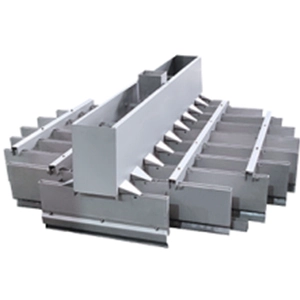
Having the core packing alone is not sufficient to deliver a stable and reliable RD system. In real plants, column internals such as distributors, supports, demisters, and redistributors play a decisive role in determining separation efficiency and the operating window.
In addition to Catapak, DODGEN provides a dedicated packing and column internals platform for reactive distillation and intensified separations. It supports structural optimization and selection based on throughput, separation difficulty, and reaction kinetics, enabling an integrated optimization of reaction rate – separation efficiency – pressure drop – liquid holdup within the same project.
(3) Integrated Technology: Catalytic Distillation / Reactive Distillation Process Packages, IP, and Engineering Implementation
As customers shift from “buying products” to “buying capacity,” what they increasingly require are process packages, simulation-based design, scale-up experience, and start-up/optimization support.
Internationally, CDTech (now within the Lummus ecosystem) is a typical representative of this category. Its catalytic distillation technology integrates reaction and separation, and Lummus continues to commercialize it under branded packages such as CDMtbe® / CDEtbe®, which are widely applied in etherification processes.
DODGEN likewise extends its capabilities to integrated process technology and engineering delivery—from conceptual design through commercial operation—helping customers translate process intensification into tangible benefits, rather than limiting value to equipment-level replacement.
(4) Catalyst Systems + Process Scale-Up Support: An Integrated R&D–Engineering Closed Loop for Esterification, Etherification, and Hydrogenation
For etherification, esterification, and hydrogenation, the catalyst system is highly coupled with the packing configuration, mass-transfer limitations, and temperature-zone control. Internationally, Johnson Matthey has strengths in catalyst systems and scale-up experience. For example, for ester hydrogenation, it offers the Gusev™ catalyst solution, highlighting high selectivity and low metal loading, together with engineering support for collaborative optimization with customers.
DODGEN’s chosen approach is to build on its core structured packing and column internals platform, and further provide catalyst system development and scale-up services. In doing so, it brings catalysis, mass transfer, thermal management, and separation into a unified engineering framework, thereby reducing customers’ trial-and-error costs.
Etherification, Esterification, and Hydrogenation: How Should the Industry Be Benchmarked? (Providing Customers with a Clear Selection Logic)
(1) Etherification: Who Can Deliver Unit-Level Benefits?
Etherification (e.g., MTBE/ETBE/TAME) is one of the most classic industrial applications of catalytic distillation / reactive distillation.
CDTech/Lummus excels in“ complete process routes and proven commercial reference projects.”
Sulzer /Koch-Glitsch excel in “RD catalytic structured packing hardware.”
DODGEN’s advantage lies in its ability to provide not only the Catapak core component, but also a column internals platform and integrated process delivery capability. This enables DODGEN to offer more complete solutions under different customer constraints—such as revamp vs. grassroots projects, energy targets, pressure-drop limits, and catalyst system requirements.
(2) Esterification: Who Can Truly “Overcome Equilibrium Limitations and Suppress Side Reactions”?
Esterification is a typical equilibrium-limited reaction. The value of reactive distillation lies in removing water or low-boiling products in situ, thereby driving the reaction toward higher conversion. Sulzer also explicitly positions its RD capability for esterification and other process-intensification applications.
DODGEN’s key competitive edge in such systems lies in the structural design of its catalytic structured packing. While ensuring high separation efficiency and low pressure drop, it provides a more stable temperature profile and a controllable catalyst volume fraction. Combined with engineering design services, DODGEN helps customers realize tangible yield improvement and energy-saving benefits in industrial units.
(3) Hydrogenation: Who Can Engineer “Catalyst + Mass Transfer + Thermal Management” as an Integrated System?
Hydrogenation is often a gas–liquid–solid multiphase system, making it more sensitive to mass transfer and thermal management. Global catalyst companies (such as Johnson Matthey, JM) emphasize catalyst selectivity and scale-up support.
DODGEN’s differentiation in hydrogenation lies in its ability to co-optimize the catalyst system with structured media, reactor internals, and process-intensification design. This is particularly suitable for operating conditions that are strongly exothermic, hot-spot sensitive, or mass-transfer limited, where structured loading can improve operational stability and extend catalyst lifetime.
Why Are More and More Customers Choosing “System Capability” Over “Single Components”?
| 회사 | Typical strengths | Best-fit scenarios | Delivery model |
| 도겐 | Catapak catalytic structured packing + column internals platform + process packages / patents + catalyst systems & scale-up support (full-chain capability) | Etherification / esterification / RD intensification + complex delivery projects (grassroots and revamps) | Core component + internals + process package + catalyst/scale-up (one-stop option) |
| Sulzer | Katapak™ catalytic structured packing for reactive distillation + column internals platform | Esterification / etherification RD; large-scale chemical plants | Core component / internals + engineering services |
| Koch-Glitsch | KATAMAX® catalytic structured packing for reactive distillation + column internals platform | Esterification / etherification RD; column revamps / debottlenecking | Core component / internals + engineering services |
| CDTech / Lummus | Catalytic distillation / reactive distillation process technology and commercialized routes (e.g., etherification) | Etherification CD process-package projects | Process package / patents / engineering implementation (often integrated with the unit) |
| Johnson Matthey | Catalyst systems (incl. hydrogenation, ester hydrogenation, etc.) + scale-up and application support | Hydrogenation, ester hydrogenation, and catalyst replacement/optimization projects | Catalyst supply + scale-up / application services |
At this stage of industry development, the key success factors for reactive distillation / catalytic distillation projects are no longer simply “whether catalytic packing exists,” but rather:
(1) Whether the core component is stable and reproducible (mechanical strength, consistency, and no catalyst loss);
(2) Whether the column internals and hydraulics are properly matched (distribution, liquid holdup, and pressure-drop window);
(3) Whether the process package is implementable (simulation → scale-up → commissioning/start-up → optimization);
(4) Whether the catalyst system can be co-optimized (activity, selectivity, lifetime, and regeneration).
Sulzer and Koch-Glitsch remain key global benchmarks in terms of core components and engineering systems; CDTech/Lummus represents capability in catalytic distillation process routes; and Johnson Matthey represents catalyst systems plus scale-up support.
DODGEN’s positioning is to integrate these capability links within a single organization: it can provide Catapak catalytic structured packing, a complete packing and column internals platform, as well as process packages and engineering delivery, and further extend upstream to catalyst systems and scale-up support. This allows customers to achieve more predictable unit-level benefits through a shorter execution path and fewer interfaces.
Conclusion: Benchmarking Global Leaders Matters—but Delivering “Quantifiable” Customer Value Matters More
Benchmarking first-tier global brands has never been about simple replication. It is about transforming advanced process-intensification concepts into system engineering capabilities that are more closely aligned with customer needs.
Across key arenas such as etherification, esterification, and hydrogenation, 도겐 is advancing an integrated model of “core component + platform + process package + catalyst system.” This approach enables reactive distillation and catalytic distillation to scale from a handful of flagship projects to broader industrial adoption—and ultimately converts the benefits of higher conversion, lower energy consumption, reduced capital investment, and improved safety into quantifiable commercial value for customers.