التعريف
Stripping is a mass transfer process used to remove volatile components from a liquid by contacting the liquid with a gas or vapor. Steam, air, nitrogen, or another suitable stripping medium may be selected according to the properties of the target component, recovery requirements, and downstream process conditions.
Stripping works by lowering the partial pressure of the target volatile component in the contacting gas phase, creating a driving force for mass transfer from the liquid into the gas. The effectiveness of the process therefore depends on vapor-liquid equilibrium, operating temperature and pressure, phase contact efficiency, and the flow rates of both phases.
How Does Stripping Work?
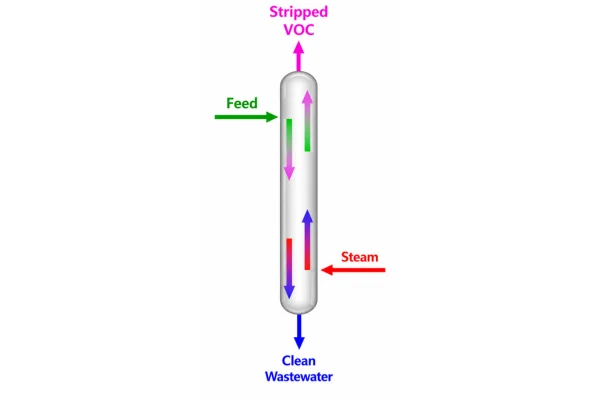
In a typical stripping column, liquid flows downward while the stripping gas or vapor moves upward, creating countercurrent gas-liquid contact. Volatile components transfer into the gas phase and leave with the overhead stream, while the treated liquid exits from the bottom.
When steam is used, volatile substances may be removed at temperatures below their normal boiling points. The overhead vapor can then be condensed and sent to phase separation or further purification when solvent or product recovery is required.
Stripping is often considered the reverse of absorption. In absorption, a component transfers from the gas phase into a liquid solvent, while in stripping, a volatile component transfers from the liquid phase into a gas or vapor stream.
التطبيقات الصناعية
Stripping is widely used for solvent recovery, volatile organic compound removal, chemical intermediate purification, dissolved gas removal, and the recovery of light components from process liquids.
In solvent-based chemical production, a stripping column may be installed downstream of a reactor or extraction unit to remove residual solvents or volatile impurities before final purification. This creates a typical process sequence:
Reactor or Extraction → Stripping → Final Purification
Stripping may also be integrated with distillation, extraction, condensation, and gas-liquid separation when a single separation operation cannot achieve the required product specification or recovery target.
الاعتبارات الهندسية
The design and operation of a stripping process require balancing separation performance, energy consumption, equipment capacity, and downstream treatment requirements.
Increasing steam or stripping gas flow can improve the mass transfer driving force and stripping efficiency, but it also increases utility consumption and may raise the load on condensers, gas-liquid separators, or downstream recovery systems.
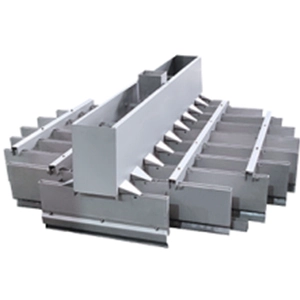
Column internals strongly influence performance. Structured packing can provide a large mass transfer area with relatively low pressure drop, while trays may be preferred under different liquid loads, operating ranges, or fouling conditions.
Process engineers must also consider vapor-liquid equilibrium, liquid-to-gas ratio, pressure drop, flooding risk, feed composition, required removal efficiency, and product purity. The appropriate stripping system therefore depends on the complete separation objective rather than the performance of the stripping column alone.
المصطلحات ذات الصلة
- Absorption
- التنقية بالبخار
- Steam Distillation
- نقل الكتلة
- Vapor-Liquid Equilibrium
- Stripping Column
- التعبئة المهيكلة
- فاصل الغاز عن السائل