حمض البوليلاكتك has become one of the fastest-growing bio-based polymers in industrial manufacturing. Its renewable feedstocks, lower fossil-carbon dependency, and biodegradable characteristics have accelerated adoption across packaging, 3D printing, disposable consumer products, and sustainable material applications.
However, many facilities discover that environmentally friendly polymers do not automatically create low-emission production environments.
Industrial PLA processing still involves thermal drying, melt conveying, extrusion, devolatilization, compounding, and repeated heat exposure. Under real workshop conditions, these operations can generate volatile organic compounds, aldehydes, oxygenated degradation products, and localized odor accumulation that directly influence indoor air quality and long-term occupational exposure conditions.
For many manufacturers, the challenge is no longer whether PLA is sustainable.
The real challenge is whether large-scale PLA production can remain operationally stable while simultaneously controlling workshop emissions, operator exposure, energy consumption, and environmental compliance pressure.
Why PLA Processing Workshops Still Experience VOC and Odor Issues
PLA is often promoted as a cleaner alternative to petroleum-derived polymers such as ABS and polystyrene. From a lifecycle carbon perspective, this is generally accurate.
However, real manufacturing environments operate under very different conditions from laboratory-scale demonstrations.
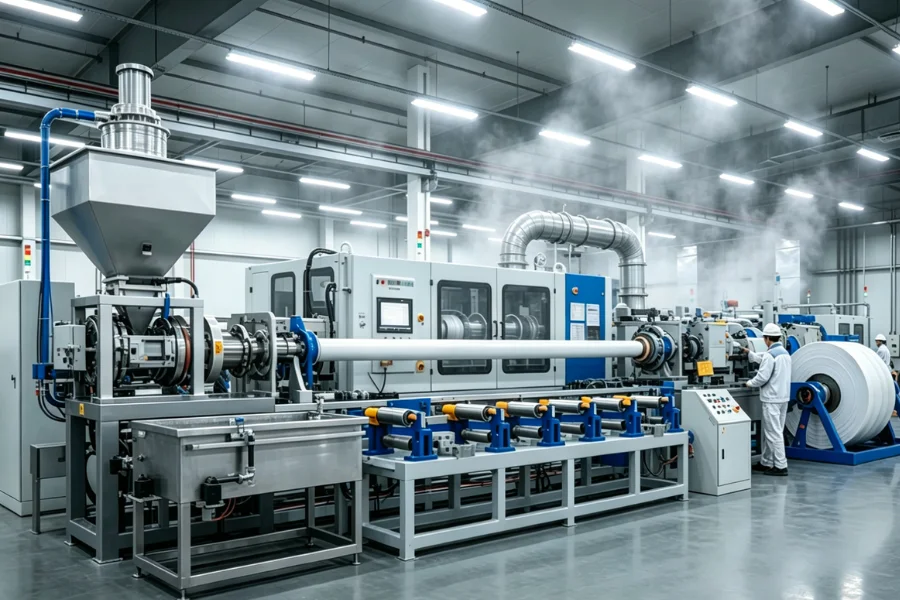
Industrial PLA workshops typically involve:
- Continuous extrusion lines
- Multi-zone heated barrels
- Hopper drying systems
- Vacuum vent sections
- Additive feeding systems
- Melt filtration units
- Pellet conveying systems
- Recycled material blending
- Long-duration production campaigns
Under these conditions, thermal degradation reactions may still occur even when processing temperatures remain inside nominal operating windows.
Several studies involving thermal polymer processing environments reported increases in aldehyde and oxygenated VOC emissions once extrusion temperatures exceeded approximately 200–220°C, particularly during long residence-time operation or oxygen-rich processing conditions.
In practice, production supervisors often notice odor intensity increasing during periods of unstable throughput rather than during steady-state operation itself.
Operators sometimes report stronger sweet-smelling vapor accumulation near pellet loading stations shortly after production restarts following temporary line stoppages, particularly when residual polymer remains inside heated barrels during idle conditions without sufficient purge flow.
In some facilities, maintenance teams observe that odor complaints increase after weekend shutdowns because partially degraded residual PLA remains trapped inside vent ports, melt filters, or screw transition sections before Monday startup.
These are operational realities rarely discussed in conventional sustainability-focused PLA content.
Where VOC Emissions Actually Originate During PLA Production
Many facilities initially assume VOC emissions originate only from extrusion nozzles or heated die sections.
In reality, emissions often develop across multiple process stages simultaneously.
Hopper Drying and Pellet Conditioning Systems
PLA is highly moisture-sensitive.
Before extrusion, pellets typically undergo drying between 60–90°C to prevent hydrolysis during melt processing. However, poorly balanced airflow inside drying hoppers can create localized overheating near lower cone sections or stagnant airflow regions.
When airflow distribution becomes uneven, certain pellet zones may experience prolonged heat exposure, increasing low-level thermal degradation before extrusion even begins.
Some process engineers report that odor intensity becomes noticeably stronger during periods of elevated ambient humidity because drying systems compensate through longer heating cycles and higher air circulation loads.
Facilities operating high-throughput drying systems occasionally encounter additional VOC spikes after desiccant saturation events reduce drying efficiency without immediately triggering operator alarms.
Extrusion Barrels and Screw Processing Zones
Extrusion remains one of the most important VOC generation stages during PLA processing.
Inside heated barrels, PLA experiences:
- Thermal shear stress
- Melt compression
- Oxygen exposure
- Pressure fluctuation
- Residence-time variation
These conditions can accelerate chain scission and depolymerization reactions.
Common VOC-related compounds associated with PLA thermal processing include:
- Acetaldehyde
- Lactide
- Alcohol compounds
- Ketones
- Organic acids
- Oxygenated degradation products
Several thermal processing studies reported measurable increases in aldehyde formation as extrusion temperatures moved beyond conventional PLA processing windows near 200–220°C.
However, temperature alone is not the only factor.
Screw configuration also strongly influences emission behavior.
Barrier screw designs with aggressive mixing sections may improve melt homogeneity while simultaneously increasing localized shear heating and polymer residence time. Some operators lower barrel-zone temperatures to reduce odor intensity, only to later encounter unstable die pressure, inconsistent melt flow, or feeder surging during higher throughput operation.
This creates a common engineering contradiction inside PLA workshops:
Lower thermal stress may reduce VOC formation while simultaneously reducing extrusion stability and production consistency.
Process engineers often face trade-offs between:
- Emission reduction
- Throughput stability
- Melt uniformity
- Product quality
- كفاءة الطاقة
These trade-offs become even more severe during recycled PLA processing.
Vent Ports and Vacuum Devolatilization Sections
Industrial PLA systems increasingly incorporate vented extrusion or vacuum devolatilization sections to remove moisture and volatile degradation products.
While these systems improve product quality, they also create additional air-management complexity.
Operators occasionally observe vapor condensation around vent-port exhaust lines during colder morning startup conditions when exhaust temperature rapidly decreases inside insufficiently insulated duct sections.
If vent-port airflow becomes unstable, partially condensed oligomer residues may gradually accumulate around extraction piping and contribute to long-term odor persistence.
Maintenance personnel sometimes discover that airflow dead zones near improperly positioned exhaust hoods allow vapor recirculation back toward operator walkways instead of fully removing emissions from the process area.
In high-throughput systems, unstable vacuum loading may also contribute to intermittent pressure pulsing inside devolatilization zones, especially when melt viscosity fluctuates during material transition periods.
Melt Filtration and Screen Change Operations
VOC release frequently intensifies during manual maintenance activities.
Screen changes, barrel cleaning, die maintenance, and purge operations often expose partially degraded polymer residues directly to workshop air.
Some EHS managers report that short-duration maintenance activities can temporarily create higher localized odor intensity than normal continuous operation itself.
This issue becomes more noticeable in facilities processing filled or additive-rich PLA compounds because degraded residues may remain trapped inside melt filtration assemblies for extended periods before maintenance shutdown.
Cooling, Pelletizing, and Conveying Areas
VOC formation does not immediately stop after polymer exits the die.
Hot strands and freshly pelletized material may continue releasing low-level organic compounds during cooling and conveying stages.
Operators working near enclosed pellet conveying systems occasionally report stronger odor accumulation during overnight production shifts when workshop airflow velocity decreases after partial HVAC setback operation.
In some facilities, fine particulate accumulation near pellet transfer systems combines with semi-volatile organic residues, gradually forming persistent odor zones near enclosed conveyor sections.
Typical VOCs Detected in PLA Manufacturing Environments
Compared with ABS processing, PLA generally produces lower total VOC emissions. However, measurable emissions still occur under industrial operating conditions.
Studies involving thermal extrusion and polymer processing environments have identified compounds such as:
- Acetaldehyde
- Lactide
- Ethanol
- Isopropyl alcohol
- Hexanal
- Ketones
- Organic acids
- Acrylic-related compounds
Some studies also reported oxygenated VOC increases under oxygen-rich thermal conditions, indicating that secondary oxidation reactions may significantly influence final workshop air composition.
This distinction is important because many compounds detected in production workshops are not emitted directly from PLA itself.
Instead, they may form through:
- Secondary VOC formation
- Radical oxidation pathways
- Indoor ozone interactions
- Thermal oxidation reactions
- Photooxidation processes
- Oxygen-driven degradation chemistry
Several laboratory investigations comparing oxygen-rich and inert processing conditions reported larger VOC diversity under oxygen exposure, supporting the role of secondary atmospheric reactions during thermal polymer processing.
In practical terms, this means workshop air quality may continue changing after emissions leave the extrusion system itself.
Facilities with strong lighting systems, elevated ozone exposure, or insufficient fresh-air replacement may unintentionally promote additional secondary oxidation inside enclosed production spaces.
Why Processing Parameters Strongly Influence Workshop Air Quality
Industrial VOC behavior is highly sensitive to operational parameters.
Small process adjustments can significantly alter emission profiles.
Temperature Stability
Temperature remains one of the most influential variables.
Many facilities focus only on average barrel temperature while overlooking barrel-zone imbalance between feed, compression, and metering sections.
In practice, localized overheating inside transition zones may create temporary thermal degradation hotspots even when displayed average temperatures appear stable.
Some maintenance teams identify odor spikes after thermocouple drift causes unnoticed overheating in mid-barrel heating zones for extended production periods.
Residence Time and Throughput
Long residence time significantly increases degradation risk.
This problem commonly appears during:
- Startup delays
- Low-throughput operation
- Unstable feeder behavior
- Line stoppages
- Material transition periods
When throughput drops while barrel heating remains active, residual polymer may remain exposed to elevated temperatures for prolonged periods.
Production supervisors occasionally report stronger aldehyde odor formation during partial-load operation than during full-capacity production because slower melt movement increases cumulative thermal exposure.
Oxygen Exposure and Secondary Oxidation
Open processing layouts allow greater oxygen interaction with heated polymer surfaces.
Oxygen-rich processing conditions may accelerate:
- Aldehyde formation
- Radical chain reactions
- Oxidation product generation
- Secondary VOC formation
Some process engineers attempt to improve workshop comfort by increasing local airflow velocity around extrusion systems. However, excessive airflow occasionally destabilizes thermal control around sensitive die zones and unintentionally alters cooling consistency.
This creates another industrial contradiction:
Higher airflow improves VOC dilution while simultaneously increasing thermal instability around precision extrusion equipment.
Recycled PLA Integration
Recycled PLA introduces additional complexity.
Repeated melt histories reduce thermal stability while increasing variability in degradation behavior.
Facilities attempting to improve sustainability metrics through high recycled-content integration sometimes experience:
- Increased odor variability
- Greater vent loading
- More unstable devolatilization behavior
- Higher aldehyde formation
- Increased screen-change frequency
These operational consequences are often underestimated during early sustainability planning stages.
Occupational Exposure, Compliance Pressure, and EHS Concerns
Most PLA workshops do not experience acute toxicity conditions comparable to high-solvent chemical plants.
However, long-term low-level exposure remains an important industrial concern.
Potential exposure-related issues include:
- Chronic odor fatigue
- Eye irritation
- Respiratory discomfort
- Operator dissatisfaction
- Localized exposure hotspots
- Long-shift inhalation exposure
Many facilities now face increasing pressure from:
- OSHA exposure expectations
- Indoor air quality standards
- ESG reporting requirements
- Customer sustainability audits
- Export compliance assessments
- Worker exposure documentation
EHS managers increasingly recognize that “bio-based” labeling alone does not eliminate audit risk.
Several multinational customers now request documentation related to:
- VOC mitigation
- Worker exposure control
- Airflow management
- Sustainable manufacturing practices
- Indoor environmental quality
In some export-oriented facilities, customer sustainability assessments now evaluate workshop environmental conditions alongside carbon-footprint metrics.
This changes the discussion from simple environmental branding into measurable operational compliance.
Ventilation Engineering Strategies for PLA Production Workshops
Ventilation design has become one of the most underestimated parts of sustainable polymer manufacturing.
Many facilities initially install general dilution ventilation systems only to later discover persistent localized vapor accumulation near extrusion lines or pellet transfer zones.
Effective VOC control typically requires layered engineering strategies.
Local Exhaust Ventilation
Localized capture systems positioned near:
- Die exits
- Vent ports
- Pelletizing systems
- Purge stations
- Screen-change areas
can significantly reduce operator exposure.
However, exhaust hood positioning matters considerably.
Poorly positioned extraction systems may unintentionally pull vapor clouds across operator pathways before full capture occurs.
Ventilation contractors sometimes discover that slight hood-angle adjustments improve capture efficiency more effectively than simply increasing exhaust airflow volume.
Negative Pressure Zoning
Some advanced PLA facilities separate production workshops into pressure-controlled airflow zones.
This approach helps prevent vapor migration into:
- Quality-control rooms
- Packaging zones
- Operator offices
- Finished-product storage areas
Negative-pressure extrusion rooms are becoming increasingly common in facilities processing recycled or additive-heavy PLA compounds.
Filtration and VOC Treatment Systems
VOC treatment selection depends heavily on actual emission composition.
Common solutions include:
- Activated carbon adsorption
- Catalytic oxidation
- Thermal oxidation
- Hybrid filtration systems
- Condensation-assisted recovery systems
However, filtration systems introduce additional economic trade-offs.
Activated carbon systems may reduce installation complexity while increasing long-term replacement and maintenance costs. Thermal oxidation systems improve destruction efficiency but significantly increase energy consumption and operating expenses.
Some facilities discover that aggressive VOC treatment systems increase overall sustainability burden through higher electricity usage and thermal energy demand.
This creates another important industrial contradiction:
Improved emission control does not always guarantee lower total environmental impact.
Reducing VOC Emissions Without Sacrificing Production Stability
The most successful PLA manufacturers typically avoid single-variable optimization.
Instead, they focus on balancing:
- Product quality
- Throughput consistency
- Air quality
- كفاءة الطاقة
- Maintenance burden
- Sustainability goals
Effective operational strategies often include:
- Improved barrel-zone balancing
- Optimized screw configuration
- Reduced idle heating duration
- Faster purge procedures
- Stabilized feeder systems
- Controlled recycled-content ratios
- Preventive thermocouple calibration
- Improved vent-port insulation
- Low-emission additive selection
Some facilities also redesign workshop layouts to physically isolate thermal processing equipment from high-occupancy operator zones.
In practice, layout optimization sometimes improves exposure conditions more effectively than expensive filtration retrofits alone.
Green Chemistry and the Future of Low-Emission PLA Manufacturing
Future PLA manufacturing will likely move beyond biodegradable feedstocks alone.
The next generation of sustainable polymer systems will increasingly focus on:
- Low-temperature polymerization
- Cleaner catalyst systems
- Low-emission additive chemistry
- Closed-loop material recovery
- Solvent-free processing
- Renewable-energy integration
- Carbon-aware process engineering
Researchers are also exploring process pathways involving:
- Supercritical CO₂ systems
- Advanced devolatilization technology
- Lower-shear extrusion designs
- Precision thermal management
- Improved oxidation resistance
As sustainability expectations continue increasing, manufacturers will likely face growing pressure to demonstrate not only renewable material usage, but also measurable improvements in workshop environmental performance and worker exposure reduction.
What Industrial Manufacturers Should Prioritize During PLA Scale-Up
As PLA production capacity expands globally, workshop air quality management will increasingly become a scale-up engineering issue rather than simply an environmental compliance task.
Pilot-scale airflow assumptions often fail after commercial expansion increases:
- الإنتاجية
- Thermal load
- Ventilation demand
- VOC concentration variability
- Operator density
- Additive complexity
Facilities planning large-scale PLA expansion should prioritize:
- Real-time air monitoring
- Process stability analysis
- VOC mapping
- Exposure hotspot identification
- Ventilation scalability
- Maintenance accessibility
- Energy-performance balance
- Long-term compliance planning
Ultimately, sustainable polymer manufacturing depends not only on what materials are produced, but also on how stable, controllable, and environmentally manageable the entire production ecosystem becomes under real industrial operating conditions.